AI Content Strategy in 2026: We Built a System That Runs Itself

Sponsored
Sponsored
Most brands don’t have an AI content strategy. They have a tool list. A few ChatGPT prompts, a Jasper subscription nobody uses, and a Notion doc titled “AI ideas” that hasn’t been opened since March. That’s not a strategy. That’s expensive procrastination. We run two creative agencies at JZ Creates, and over the last year we rebuilt our entire content engine around AI. The result is a system that produces blogs, YouTube videos, social posts, and newsletters on a repeatable schedule, with one practitioner reviewing instead of a team writing from scratch. This is the playbook.
Key Takeaways
- An AI content strategy is not a tool list. It’s a five-layer system covering audience, keywords, production, distribution, and measurement.
- The biggest unlock in 2026 is not better AI. It’s better workflow design around the AI you already have.
- The brands winning right now are optimizing for AI search (Google AI Overviews, ChatGPT, Perplexity), not just classic SEO.
- One creative with the right AI content strategy can outproduce a five-person content team running the old way.
- Most marketing directors are stuck at “we use ChatGPT sometimes.” The gap to “we run an AI content system” is wider than people think, and that’s where the competitive advantage lives.
What Is AI Content Strategy?
An AI content strategy is a documented system for using artificial intelligence across the full content lifecycle: research, creation, optimization, distribution, and measurement. It defines what humans do, what AI does, where the handoffs happen, and how the brand voice stays consistent across every output. Without that documentation, AI just becomes another tool people use inconsistently. With it, AI becomes the operating system of your content team.
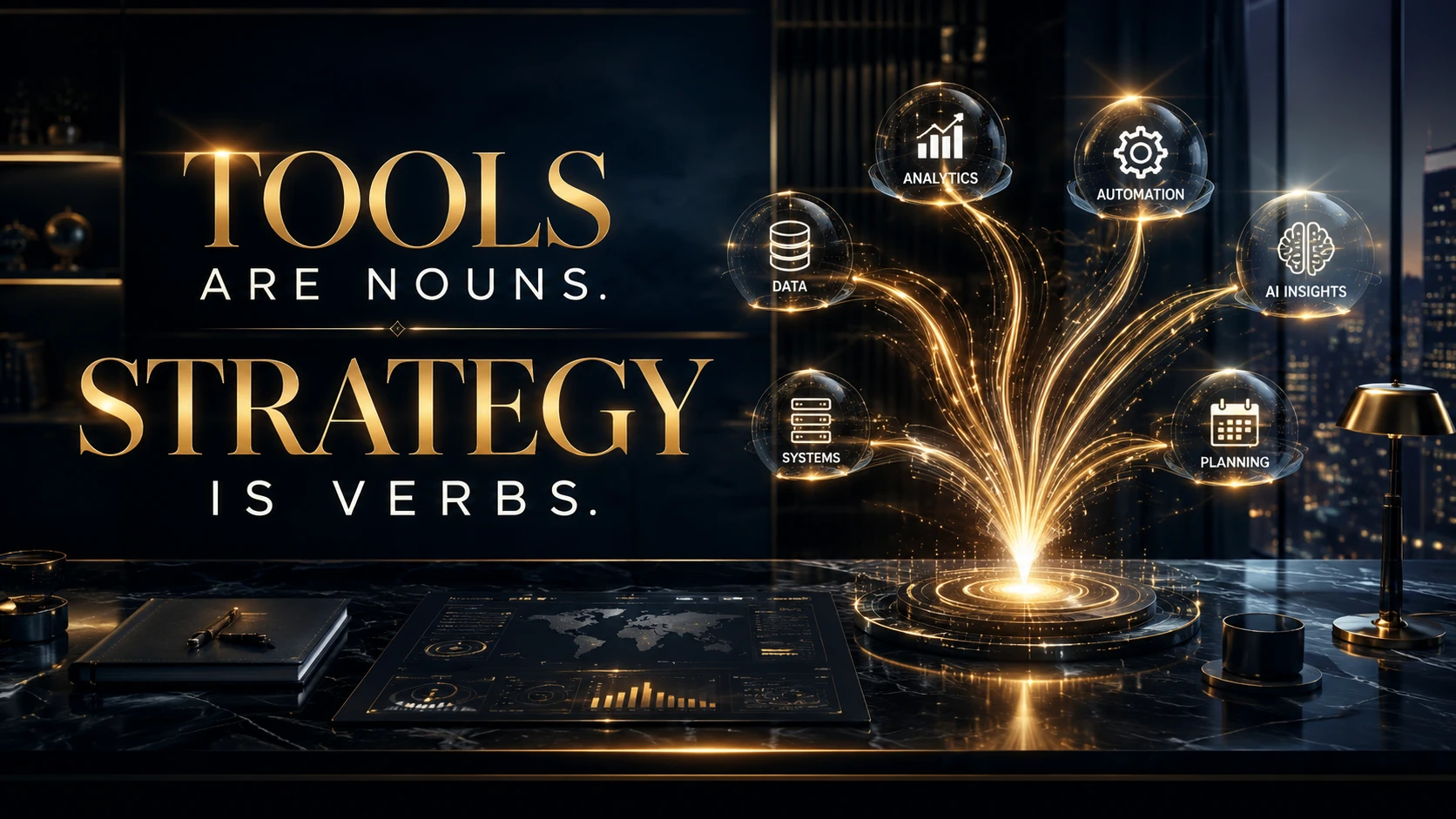
The short version: tools are nouns, strategy is verbs. The strategy is what tells the tools when, why, and how to fire.
Why Every Brand Needs an AI Content Strategy in 2026
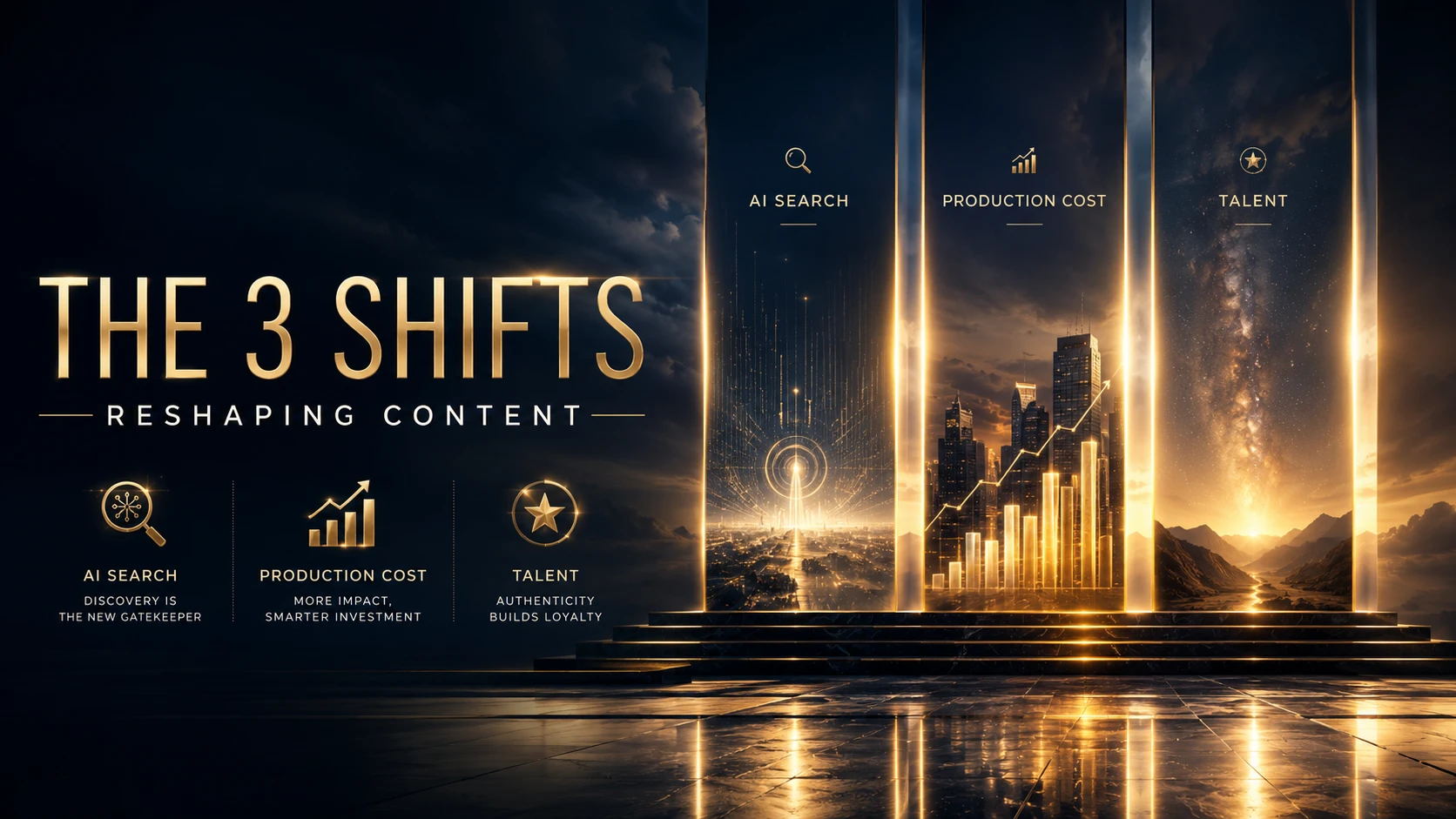
Three things changed this year, and most marketing teams have not caught up to any of them.
Search is no longer a list of blue links. Google AI Overviews now appear on the majority of informational queries. ChatGPT, Claude, Perplexity, and Gemini are answering questions before users ever click a link. If your content is not structured to be cited inside those answers, your traffic is quietly leaking out of the top of the funnel. A recent Pew Research study showed users click traditional results far less when an AI summary is present.
Production cost has collapsed for the brands that know what they’re doing. A luxury campaign that took six weeks two years ago can now ship in five days if the AI content strategy is in place. The brands without one are still paying the old prices, often for worse output.
Talent is being repriced. The most valuable people on a marketing team are not the fastest writers anymore. They’re the strategists and editors who can direct AI to produce on-brand work at scale. That’s a different skill set, and the org chart is shifting fast.
Our AI Content Strategy Framework in Five Layers
This is the framework we use at JZ Creates for our own brand and for clients. Five layers, in order. Skip any one of them and the whole stack wobbles.
Layer 1: Audience and Brand Voice
You cannot delegate to AI what you cannot articulate yourself. Before any tool fires, we document three things:
- Who the audience is, specifically. Not “marketers.” It’s “marketing directors at luxury consumer brands who are tired of agencies that don’t understand the category.”
- The brand voice, in writing. Tone, sentence rhythm, words to use, words to ban, point of view, humor style, and credibility patterns. Ours lives in a file we call `voice.md` and we feed it to every model that produces text.
- The strategic point of view. What does the brand actually believe? Bland content is the default output of every AI model on earth. Opinion is the antidote.
This layer is where most AI content fails. The output reads like AI not because the model is bad, but because the brand never told it what it sounds like.
Layer 2: The Keyword and Topic Engine
This is the research layer. We use SE Ranking and DataForSEO to pull keyword data, then run the export through Claude Code to build keyword clusters and competitor analysis on every target topic. The output is a brief with:
- Primary keyword, supporting cluster, intent, volume, difficulty
- Top 10 organic results with format pattern and gaps
- People Also Ask questions to cover in the FAQ
- AI Overview signals (is one present? what does it cite?)
This brief is what every downstream piece of content is built from. No brief, no production. That single rule cuts our content waste in half.
Layer 3: The AI Production Stack
This is the part everyone wants to skip to. Resist that. Without Layers 1 and 2, this layer produces fast slop. With them, it produces premium ai-driven content at scale.
Our 2026 stack for AI-powered content:
- Claude Code 4.8 for blog generation, editorial review, and workflow logic (the version that just shipped is a noticeable step up on long-context reasoning)
- HeyGen Hyperframes for AI video production at agency scale
- ElevenLabs for voice cloning so the YouTube and podcast versions sound like the founder, not a stock voice
- Kling, Seedance, and Runway for cinematic AI video clips (we covered this in our roundup of the best text to video AI tools and our wider stack of AI tools for content creators)
- Nano Banana and ChatGPT image generation for cover art and in-post visuals
The key principle: one source brief produces every output. Blog, YouTube script, newsletter, LinkedIn post, and social clips all derive from the same strategic source. That is what generative AI for content strategy actually unlocks. Same idea, ten formats, one approval cycle.

Layer 4: Distribution Automation
Production is the bottleneck people obsess over. Distribution is the bottleneck that quietly eats the budget. Our content marketing strategy AI workflows for distribution use:
- GoHighLevel as the all-in-one backbone for newsletter, social posting, CRM, websites, and funnels. We’ve run our agency on it for three years and it has done more to scale our distribution than any other single platform in the stack.
- n8n as the custom orchestration layer for anything GoHighLevel doesn’t natively cover, self-hosted on Railway
- Blotato as a backup for multi-platform social pushes when we need more granular control
- WordPress with a custom publishing pipeline that handles SEO meta, internal linking, and image conversion automatically
The result is that one blog post becomes thirty distribution events without anyone copy-pasting captions at 11pm on a Sunday.
Layer 5: Measurement and Iteration
Most AI content programs never get measured because the team is too busy producing. We track three things and ignore everything else:
- What is ranking in AI Overviews and Perplexity citations, not just classic SERPs
- Which posts drove inbound conversations, not just traffic
- What the cost-per-published-piece is over time, including human review hours
That last number is the one nobody on LinkedIn talks about. It’s also the only one that proves the strategy is working. The goal is for it to drop steadily quarter over quarter while quality stays flat or improves.
How to Use AI for Content Strategy (The Step by Step)
Practical version. This is the order we run every new content cycle in.
- Pull keyword data from SE Ranking or DataForSEO. Filter by volume above 100, difficulty 30 or under, informational intent.
- Feed the export to Claude Code with the brand voice and audience files. Generate a keyword cluster and three to five article briefs.
- Pick the article with the highest opportunity score (volume times winnability).
- Have AI analyze the top three organic results and identify the format, the gaps, and the angle to steal.
- Draft the blog post against the brief, with the brand voice file loaded in context.
- Review, edit, inject opinion and real examples. This is the human step that cannot be skipped.
- Derive the YouTube script, newsletter, LinkedIn post, and social clips from the approved blog.
- Publish via the automation pipeline. Measure what gets cited, not just what gets clicked.
That loop runs weekly at JZ Creates. The compounding effect over a year is the difference between a content program and a content brand.

The Role of the AI Content Strategist
Worth saying out loud: this changes the job. The role of the ai content strategist in 2026 is closer to a creative director than a writer. You are not producing every word anymore. You are designing the system that produces the words, defining the voice, choosing what to publish, and editing the AI output so it reads like a human who knows what they’re talking about.
The teams that promote their best editors into this role are the teams winning right now. The teams trying to scale by hiring more junior writers are losing ground every month.
What Brands Get Wrong
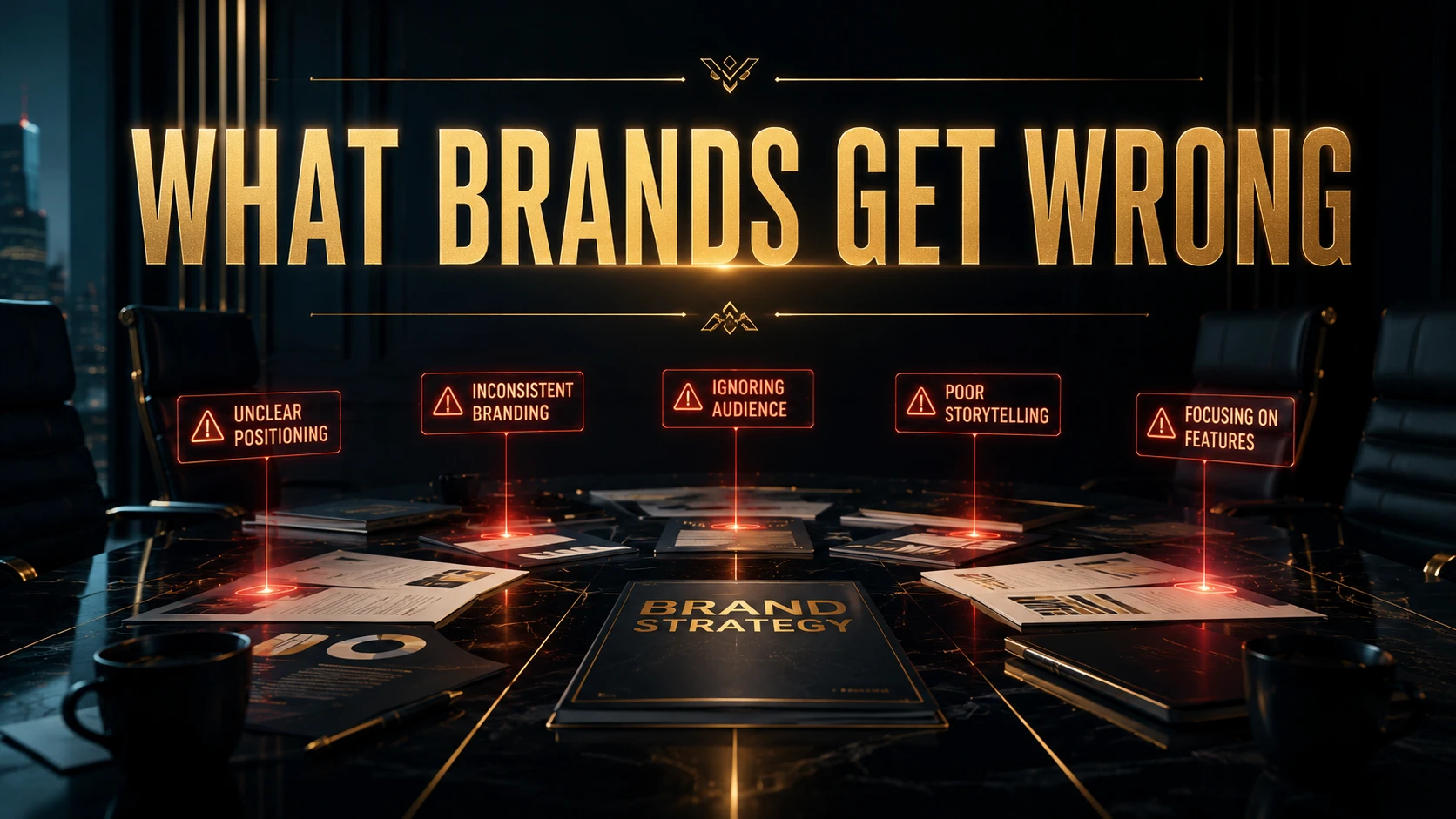
Five mistakes we see constantly when marketing directors ask us to audit their AI content strategy:
- No brand voice documentation. Output reads like every other AI blog because the model has nothing to anchor to.
- Tool stacking without workflow design. Buying five AI subscriptions and using none of them well.
- Optimizing only for Google, not for AI search. Missing the cite-worthy structure that gets pulled into AI Overviews.
- No measurement on cost-per-piece. No way to prove the strategy is paying back.
- Skipping the human review step to “save time.” This is how AI slop ends up on a luxury brand’s homepage. Nobody saves time by publishing work the audience does not trust.
What We Actually Use at JZ Creates
Our own stack, lifted from our internal docs:
- Strategy and editorial: Claude Code 4.8
- Voice and audio: ElevenLabs for voice cloning
- Video: HeyGen Hyperframes for the talking-head production, Kling and Seedance for cinematic clips
- All in one growth platform: GoHighLevel for newsletter, social posting, CRM, and websites
- Custom automation: n8n self-hosted, plus a custom WordPress publishing script
- Research: SE Ranking and DataForSEO
Behind that stack is 20 years of agency experience producing campaigns for major studios, which is what taught us the rule we keep coming back to: great creative equals great results, no matter what tool you use to make it. AI is the multiplier. The taste is still the moat.
The Bottom Line
An AI content strategy is not a quarterly initiative. It is the operating model for how a modern brand produces content. The brands that document their voice, build the production stack, automate distribution, and measure what actually matters are going to dominate the next 24 months. The brands still treating ChatGPT as a writing helper will spend the same money and get less reach every quarter.
If you want help building your AI content strategy, or you want us to run it for you, send us a message and let’s talk about what your brand actually needs. We do this every day for AI creative services clients, and we also handle the full automation layer through our AI creative automation services. We’d love to see what we can build for you.
Frequently Asked Questions
What is AI content strategy?
An AI content strategy is a documented system for using artificial intelligence across the full content lifecycle: audience definition, keyword research, production, distribution, and measurement. It defines what humans do, what AI does, and how brand voice stays consistent at scale. Without that documentation, AI just becomes scattered tool usage. With it, AI becomes the operating layer of your content team.
Which AI is best for content strategy?
There is no single best tool. For strategy and editorial work we use Claude Code 4.8. For research we use SE Ranking and DataForSEO. For video we use HeyGen Hyperframes, Kling, and Seedance. For voice we use ElevenLabs. For all in one distribution we use GoHighLevel. The best AI for content strategy is the one wired into a documented workflow with your brand voice attached.
What is the 10 20 70 rule for AI?
The 10 20 70 rule says 10% of AI value comes from the algorithm, 20% from the data, and 70% from the workflow and people around it. Applied to content, it means picking a slightly better model matters less than designing a great brief, voice file, and review process around whatever model you use.
What is the 3 3 3 rule in marketing?
The 3 3 3 rule says any marketing message should be understandable in 3 seconds, interesting in 30 seconds, and convincing in 3 minutes. Applied to AI content strategy, it forces the same discipline on AI output that you’d apply to human writing: hook in the first sentence, value in the first scroll, payoff before the reader bounces.
How do I start building an AI content strategy?
Start with Layer 1 of the framework above. Document your audience, your brand voice, and your point of view in writing. Then add the keyword engine, the production stack, the distribution layer, and the measurement loop in order. Most brands try to start at Layer 3 by buying tools, and that is why their AI content reads like everyone else’s AI content.
Is AI content bad for SEO?
Only if it is bad content. Google has been clear: helpful content ranks regardless of how it was made. AI content that is reviewed, edited, opinionated, and grounded in real expertise performs the same as human content. AI content that is published unedited from a generic prompt does not, and that is the entire reason this strategy matters.

About Jay Hernandez
Jay Hernandez is an award-winning Creative Director with 20+ years of driving standout campaigns for top brands. Based in Los Angeles, he blends deep creative expertise with cutting-edge AI tools to help businesses and marketing teams unlock bold, breakthrough ideas that deliver real impact. If you are ready to elevate your brand and turn big visions into unforgettable campaigns, connect with Jay and make it happen.
Share This Article
Sponsored