How to Build an AI YouTube Channel for Your Brand in 2026
Sponsored
Sponsored
Key Takeaways
- An AI YouTube channel built with the right stack can go from zero to a real posting cadence in weeks, not the six-month runway a traditional in-house video team needs.
- The channel foundation that compounds is a narrow niche, a consistent upload rhythm, and a hook written before a single frame gets generated.
- AI covers scripting, voice, and b-roll motion, but the retention layer (pacing, thumbnails, the first three seconds) still needs a human editorial pass.
- Short-form and long-form need different cadences and different tools inside the same channel; treating them the same is the fastest way to stall growth.
- The brands winning with AI YouTube channels right now are the ones publishing weekly, not the ones waiting for a perfect first video.
We just watched a client go from an empty YouTube channel to a real subscriber base in eleven weeks, and the thing that got them there wasn’t a bigger budget. It was a system. Most brands treat YouTube like a someday project because the old math (a camera crew, an editor, a six-week turnaround per video) never penciled out next to Instagram and TikTok. That math is gone now, and almost nobody has updated their plan to reflect it.
Why Brands Are Finally Taking AI YouTube Channels Seriously
YouTube rewards consistency more than any other platform. The algorithm is patient with brands that show up weekly and merciless with the ones that post six videos in a burst and go quiet for two months. That consistency requirement is exactly what used to price small and mid-size brands out of the platform, because a real production pipeline is expensive to keep running every single week.
At JZ Creates, a creative agency built around AI and automation for brands, this is the exact gap our AI creative services work gets asked to close. Founders and marketing directors already know they should have a channel. What stops them is not vision, it’s throughput.
“The brands that win on YouTube in 2026 aren’t the ones with the biggest budget. They’re the ones who never miss a week.” That’s not a slogan, it’s just what the data on channel growth keeps showing us.
The other shift worth naming: AI generated video no longer reads as obviously synthetic the way it did even a year ago. Viewers are far more forgiving of AI-assisted footage than they are of a channel that posts twice and disappears.
The Channel Foundation Nobody Skips
Before any tool gets opened, a brand channel needs three decisions locked: the niche, the format mix, and the cadence. Skip this step and every video after it fights an uphill battle, no matter how good the AI output looks.
Niche narrower than feels comfortable. “AI tools” is not a niche. “AI tools for boutique consumer product brands under 20 people” is a niche. The tighter the angle, the faster YouTube’s recommendation system figures out who to show the channel to.
Format mix matched to the goal. Shorts build discovery. Long-form builds trust and watch time, which is what actually moves subscriber counts. A channel leaning entirely on one or the other usually plateaus.
Shorts First Versus Long Form First: Picking a Cadence for an AI YouTube Channel
| Shorts-first cadence | Long-form-first cadence | |
|---|---|---|
| Best for | New channels needing discovery fast | Channels with an existing audience elsewhere |
| Typical output | 3 to 5 Shorts per week | 1 long-form video per week |
| AI does most of the work on | Hook variations, b-roll, captions | Scripting, voiceover, structure |
| Human pass still required | Trimming to the strongest 3 seconds | Pacing and story arc |
| Time to first real traction | 4 to 8 weeks | 8 to 16 weeks |
Most brand channels we build now start Shorts-first, because the discovery loop is faster and it gives the team real audience data before committing to a heavier long-form schedule.
The Content Engine: Scripting, Voice, and Motion
Once the foundation is set, the actual production stack does the heavy lifting, and this is where the AI YouTube channel starts producing at a pace a traditional crew can’t match.
Scripting starts with Claude, which we use for the outline, the hook variations, and tightening a script down to what actually needs to be said on camera. A script that reads well on the page and a script that holds attention out loud are two different documents, and this is the step brands skip most often.
Voice comes next. For channels without an on-camera host, or for narration layered over b-roll, ElevenLabs produces a voice track that doesn’t sound like a text reader, which matters enormously for watch time. A flat AI voice is one of the fastest ways to lose a viewer in the first ten seconds.
For motion and b-roll, Kling generates footage that would otherwise require a shoot day, a location, and a crew. It’s genuinely one of the tools that changed our own production math this year, not just something we recommend secondhand.
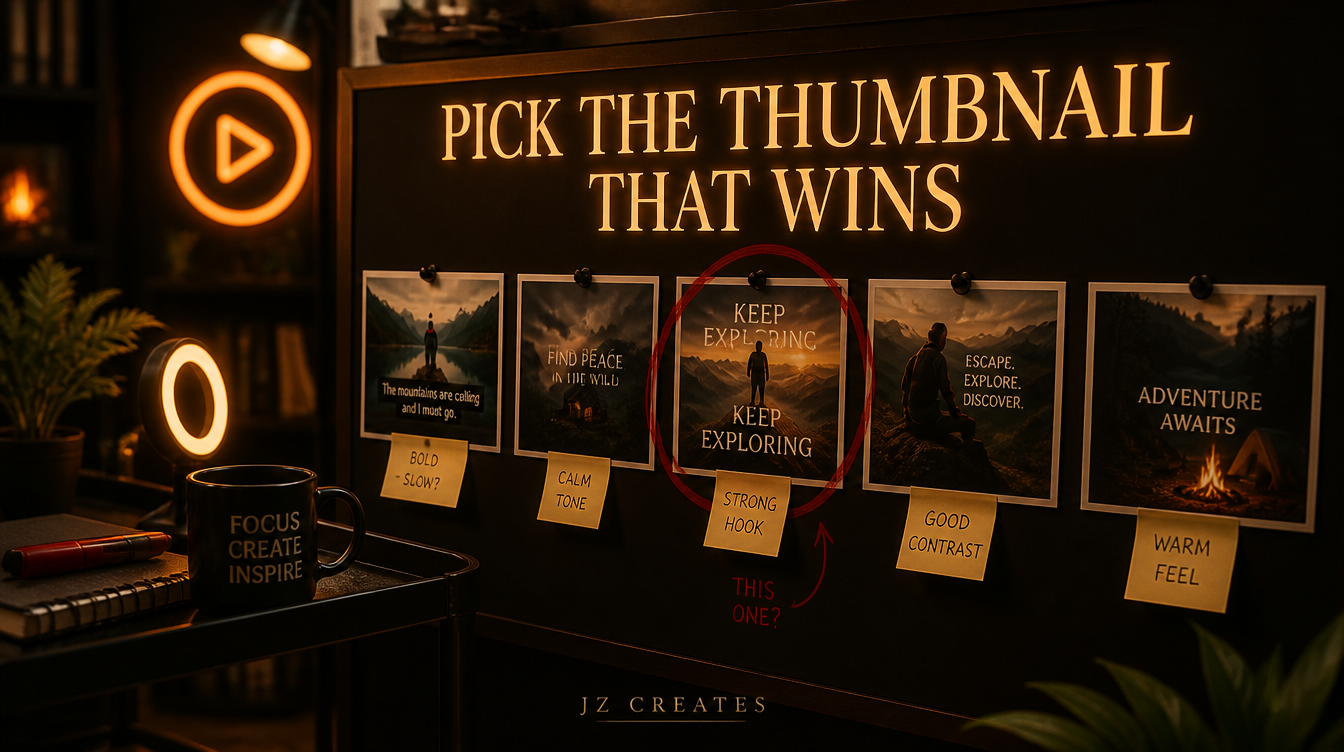
Thumbnails and channel art matter more than most brands budget for, since a thumbnail is doing the actual clicking-decision work before the video ever plays. This is where we lean on Kie.ai, a pay-as-you-go image generation tool that’s useful precisely because a channel needs dozens of thumbnail variants without committing to a subscription tier sized for a much bigger team.
The Edit and Upload Layer
Generated footage, voice, and thumbnails are raw ingredients, not a finished video. The edit pass is where a channel either feels intentional or feels assembled.
We run the final cut in CapCut, which does double duty as an editor and as a fast way to reformat a long-form video down into Shorts once the main cut is locked. That reformatting step is what actually stretches one week of production into five or six pieces of content.
Once a video is edited, distribution is its own job. We use Blotato to push the Shorts cut across platforms beyond YouTube itself, so one production week produces a channel upload and a set of native-feeling clips for Instagram and TikTok without a second production pass. This is the same layer our AI creative automation systems handle for brands managing a full posting calendar, not just a single channel.
Hook script starter: “Write 5 opening lines for a YouTube video about [topic] that each use a different hook style: a bold claim, a question, a surprising stat, a mistake to avoid, and a before/after. Keep each under 12 words.”
What Actually Makes People Subscribe
Generation speed gets a channel to a full calendar. It does not, on its own, get someone to hit subscribe. Three things do that consistently across the channels we’ve built.
The first three seconds carry the entire video. If the hook doesn’t earn the next ten seconds, retention collapses and the algorithm notices immediately. AI can generate hook variations fast, but a human still has to pick the one that’s actually true to the brand and actually interesting, not just technically correct.
Editorial judgment on pacing is the other non-negotiable. Raw AI output tends to run a beat too slow in the middle, and that’s exactly where viewers drop off. A tightened cut with the fat trimmed out is the difference between a video that gets recommended and one that dies at 40 percent watched.
Consistency beats polish. A channel posting a solid video every week for three months will outperform a channel posting one beautifully polished video every six weeks, almost every time. This is the part brands resist, because it feels like publishing before something is perfect.
Mistakes We See Brands Make With AI YouTube Channels
The most common failure isn’t picking the wrong tool, it’s skipping the foundation work above and going straight to generation. A few patterns show up over and over:
- Posting inconsistently because “the next video needs to be better,” which trains the algorithm to stop recommending the channel at all.
- Using one AI voice with zero editing pass, which reads as obviously synthetic even when the underlying generation is genuinely good.
- Copying a competitor’s format exactly instead of adapting it to a narrower niche, which means the channel never builds a distinct audience.
- Treating Shorts and long-form as the same content trimmed to a different length, instead of writing each for how people actually watch it.
What We Actually Use at JZ Creates
- Claude for scripting, hook variations, and outline structure: claude.ai
- Kling for AI-generated b-roll and motion: Kling
- ElevenLabs for narration and voiceover: ElevenLabs
- Kie.ai for thumbnail and channel art variants, pay-as-you-go: Kie.ai
- CapCut for the final edit and Shorts reformatting: CapCut
- Blotato for pushing the Shorts cut across platforms after upload: Blotato
That’s the same production logic we walked through in our AI video creation tools roundup, just tuned specifically for what a YouTube channel needs week over week, and it pairs naturally with the cross-platform distribution approach in our AI social media automation piece.
The Bottom Line
A brand YouTube channel doesn’t need a production department anymore. It needs a repeatable system: a locked niche, a cadence that matches the format, and a human editorial pass on every hook and cut. AI closes the production gap. Judgment closes the retention gap. Both are required.
If you need help with YouTube content or building a channel from scratch, that’s exactly what our team specializes in. At JZ Creates, we produce captivating, engaging video content for brands, and we can build the same scripting, voice, footage, and editing engine for your channel. Contact us so we can bring your vision to life!
FAQ
How long does it take to build an AI YouTube channel from scratch?
A Shorts-first channel can start showing real traction in four to eight weeks with a consistent posting rhythm. A long-form-first channel usually takes longer, closer to eight to sixteen weeks, because it depends more on accumulated watch time and audience trust.
Do I need to appear on camera to run an AI YouTube channel?
No. Many brand channels run entirely on voiceover narration over generated or licensed b-roll. A recognizable host can help with trust over time, but it’s not required to start posting consistently.
Is AI generated YouTube content against platform policy?
No. YouTube does not prohibit AI-assisted video. Creators are expected to follow the platform’s standard content and disclosure policies, including labeling realistic AI-generated content where YouTube’s own tools call for it.
What’s the single biggest reason AI YouTube channels stall out?
Inconsistent posting, by a wide margin. A channel that skips weeks because a video “isn’t good enough yet” trains the algorithm to stop recommending it, which is harder to recover from than shipping an imperfect video on schedule.
Should Shorts and long-form videos be scripted the same way?
No. A Short needs the hook in the first word or two and one idea only. A long-form video can build context before the payoff. Writing both from the same script template is one of the most common reasons a channel’s Shorts underperform.

About Jay Hernandez
Jay Hernandez is an award-winning Creative Director with 20+ years of driving standout campaigns for top brands. Based in Los Angeles, he blends deep creative expertise with cutting-edge AI tools to help businesses and marketing teams unlock bold, breakthrough ideas that deliver real impact. If you are ready to elevate your brand and turn big visions into unforgettable campaigns, connect with Jay and make it happen.
Share This Article
Sponsored