AI TikTok Video: A Playbook That Doesn’t Look Like AI
Sponsored
Sponsored
Key Takeaways
- AI tiktok video production only works when the hook, not the tool, does the heavy lifting. The first two seconds decide everything.
- The biggest tell that a TikTok was made with AI is not the visuals, it is pacing that is too smooth and too even. Real TikTok has friction on purpose.
- Trend jacking with AI tools only pays off if you can go from spotted trend to published post in under a few hours, not a few days.
- The winning workflow blends AI generation for speed with a human pass for voice, timing, and the small imperfections that read as real.
- We run this exact playbook for clients across consumer products, music festivals, and author brands, and the wins look different in every category.
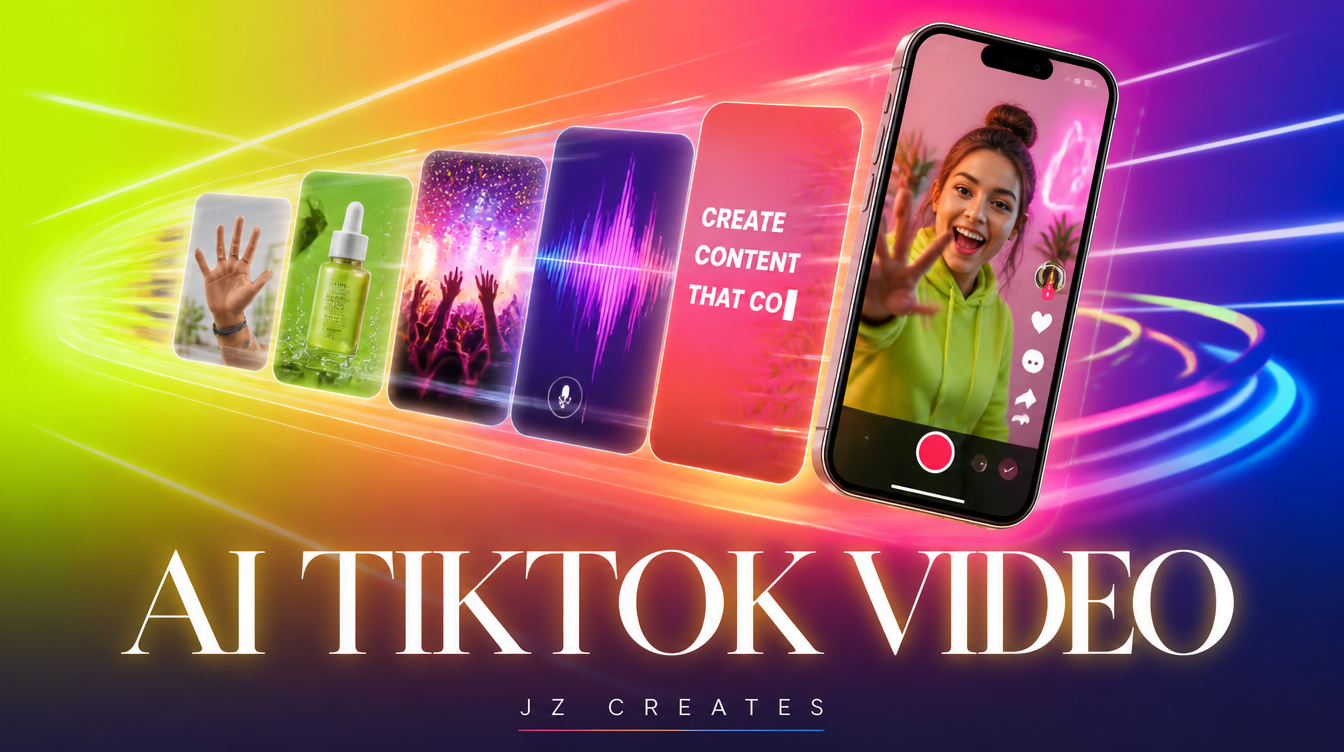
Scroll speed on TikTok is now measured in single digits. Most creators lose the viewer before the first two seconds are even over. That is the actual battleground for anyone trying to use AI to make TikTok content, and it has almost nothing to do with which model rendered the clip.
We run JZ Creates, a creative agency in Los Angeles focused on content, AI, and automation for brands, and TikTok is where we get asked the most panicked questions. Marketing directors want volume. They also want the content to not feel like it rolled off an assembly line. Those two goals fight each other constantly, and this playbook is how we make them cooperate.
The Real Bottleneck Is Speed, Not Ideas
Every brand we talk to has ideas. What they do not have is a way to turn ten ideas into ten finished, on-trend vertical videos before the trend dies. TikTok trends have a shelf life measured in days, sometimes hours. A concept that would have taken a production crew a week to shoot now needs to exist by tomorrow morning.
This is where ai tiktok video tools earn their keep. We use them to compress the distance between an idea in a Slack thread and a published clip, for clients ranging from a consumer skincare brand to a touring music festival that needs same-day recap content. Our AI creative services build this exact pipeline for brands that cannot staff a full in-house TikTok team.
The mistake most marketing teams make is treating AI TikTok video as a replacement for the creative brief. It is not. It is a replacement for the time between the brief and the first draft.
Why Most AI TikTok Content Still Looks Like AI
Here is the part nobody wants to admit: technically flawless is not the same as believable. TikTok viewers have watched thousands of hours of unpolished, handheld, slightly messy video. Their pattern recognition for “this was generated” is sharper than most marketers assume.
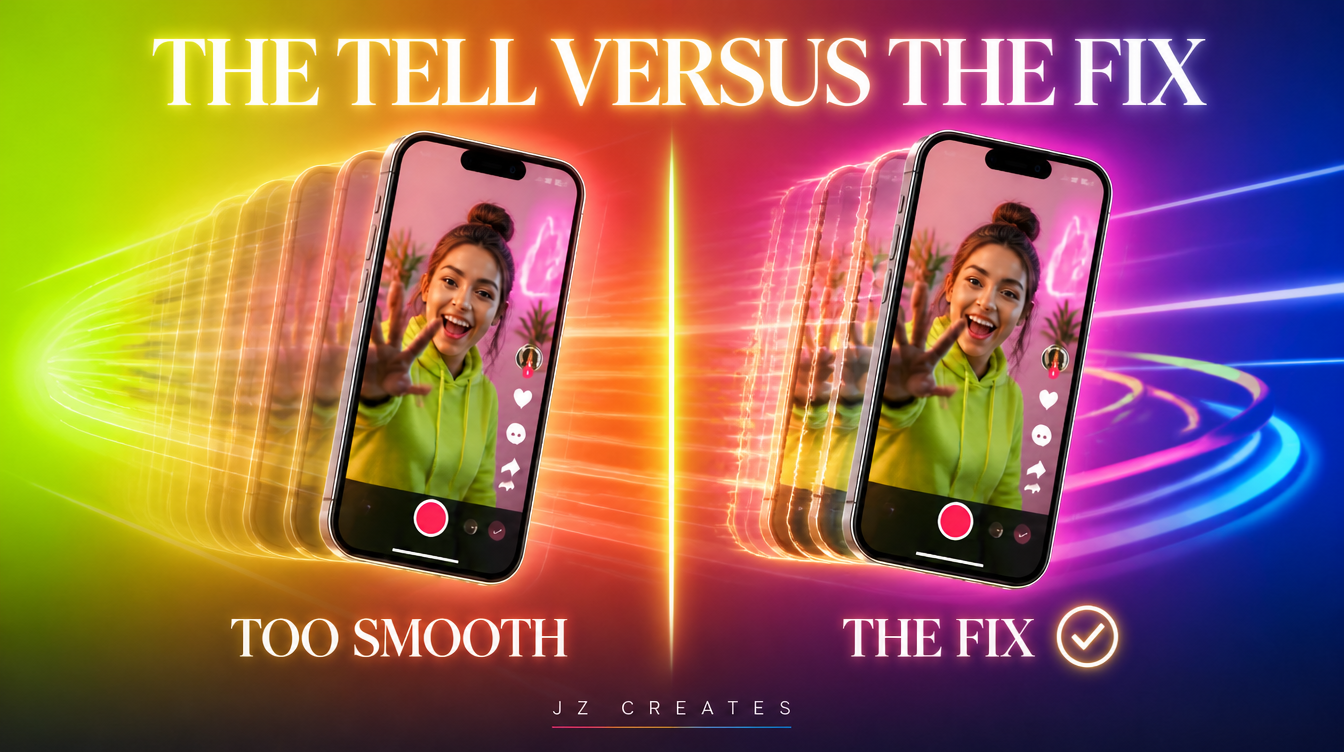
The tell: motion that is too even, cuts that land on a perfect beat every single time, faces with expressions that never quite land on a genuine one, captions that appear at a mathematically perfect interval.
The fix: we intentionally reintroduce friction. A slightly early cut. A caption that lags the voiceover by a beat, the way a human editor’s hand actually moves. A camera “move” that overshoots slightly before settling, generated with a small amount of extra motion in the prompt instead of a locked, silky pan.
The audience is not grading your video on technical polish. They are grading it on whether it feels like it happened to a real person. That is the whole game on TikTok, and it was true before AI and it is still true now.
We generate the base footage in Kling, then run it through a human edit pass before it ever gets a caption. Kling’s motion handling is strong enough that we can direct camera movement with real specificity in the prompt, which is what lets us dial the “overshoot” back in on purpose. If you are testing AI video tools for the first time, Kling is where we point most clients to start.
The Hook Is Still the Whole Game
None of the authenticity work matters if the first frame does not earn the second frame. We treat the hook as its own creative problem, separate from the rest of the script, and we write it last, after we know exactly what the payoff of the video is.
Hook generator we actually use: “Write 8 opening lines for a 15 second vertical video about [topic]. Each line must create a specific, answerable question in the viewer’s mind within the first 2 seconds. No generic hooks like ‘you won’t believe this.’ Ground each one in a concrete detail, number, or contradiction.”
We run that prompt through Claude before a single frame of video gets generated, because the script has to be locked before the visuals are worth making. Claude is genuinely the sharpest tool we have found for this kind of tight, constraint-driven copywriting, and it is the first stop in almost every AI TikTok workflow we run now.
Once the hook line is locked, we build the visual around it, not the other way around. A hook about a surprising number gets a visual that makes that number impossible to miss in frame one. A hook that poses a contradiction gets a visual split that shows both halves of it immediately.
Trend Jacking At TikTok Speed
Trend response used to mean picking a sound, filming something loosely related, and hoping the timing held. AI collapses the production time enough that we can respond to a trend the same day it starts moving, which changes the math completely.
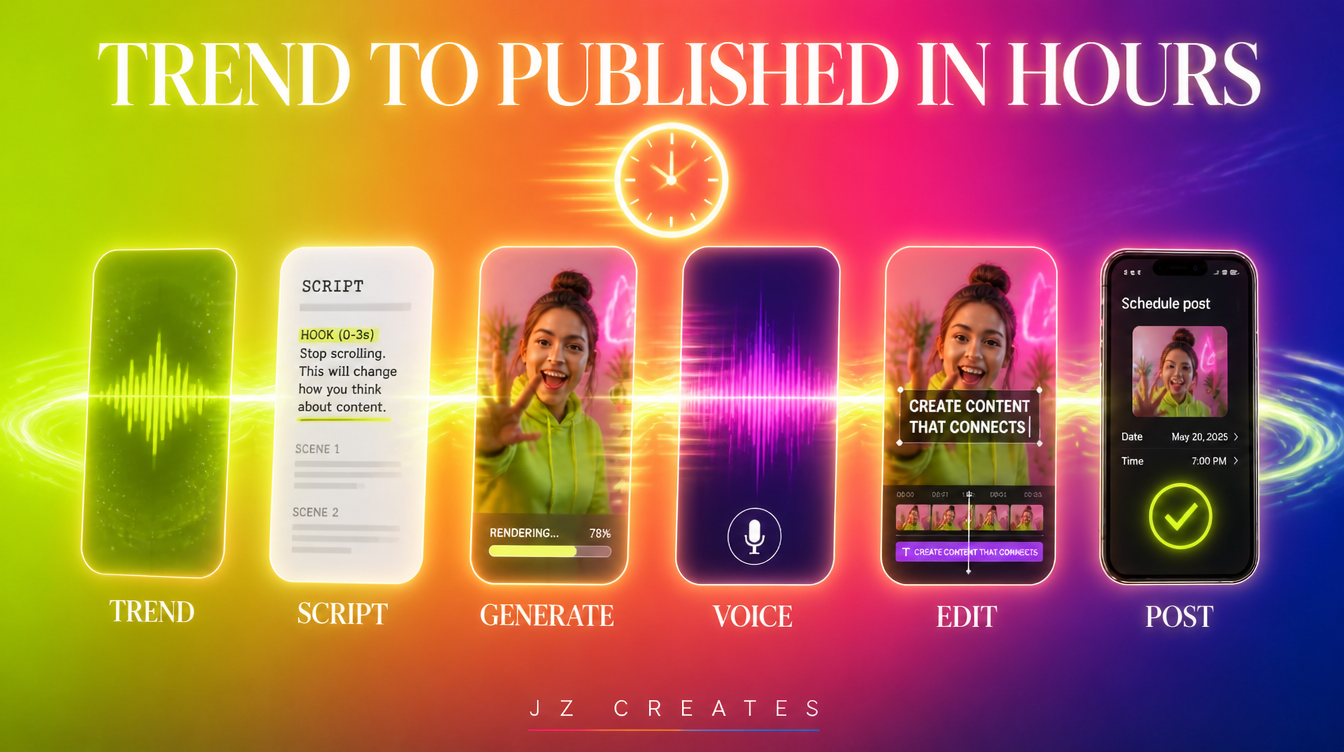
Here is the actual sequence we run when a client wants to jump on a live trend:
- Spot it fast. Someone on the team flags a trending sound, format, or meme inside the first few hours of it climbing, not after it has already peaked.
- Draft five hook variations with Claude, scoped tightly to the brand’s actual product so it does not feel like a bolted-on trend chase.
- Generate the base clips in Kling, usually two or three variations of the strongest hook.
- Voice it with ElevenLabs when the format calls for narration instead of on-camera talent, common for consumer product and author clients without a spokesperson on standby. ElevenLabs sounds conversational instead of like a corporate narrator.
- Cut it in CapCut, where the trending sound, captions, and platform-native pacing live natively. CapCut is more than a trimming tool now, it generates AI b-roll and pulls trending audio straight into the timeline.
- Queue it through our automation stack so it posts inside the trend window instead of two days after everyone has moved on.
A Music Festival, A Same-Day Recap, And What Actually Worked
One of the clearer examples of this playbook in action was a multi-day music festival client who needed same-day recap content out of every set, without a full production crew rotating through the grounds. Waiting until the following week for a polished edit was not an option.
We built a lightweight pipeline: a phone-shot crowd clip, run through Higgsfield for quick stylized product-to-video enhancement on any sponsor callouts, layered with a Claude-written caption hook, and cut same-night in CapCut with the day’s trending audio. Higgsfield gave us a way to punch up sponsor visibility without reshooting a single frame.
The lesson generalizes past music festivals. AI TikTok video wins when the constraint is time, not talent. A consumer product launching a limited drop, an author on a book tour stop, an events client covering a weekend activation, all hit the exact same wall. The content has to exist within hours or it does not matter how good it is.
The Mistakes We See Constantly
Myth: more AI-generated clips means more content that performs.
Reality: volume without a locked hook just means more videos nobody finishes watching. We would rather ship three tight fifteen-second clips than ten generic ones.
Myth: the newest video model automatically makes better TikTok content.
Reality: model quality matters less than editorial judgment. The best AI video tool still needs a person deciding what stays too polished and what needs friction added back in.
Myth: AI voiceover sounds robotic, so avoid it entirely.
Reality: current tools like ElevenLabs sound close enough to natural that the bigger risk is a script that reads like ad copy, not the voice reading it.
Our internal automation runs on n8n, wiring together the script, generation, and posting steps so the team spends their time on judgment calls, not repetitive uploads. If a brand’s TikTok volume is high enough to need real scheduling automation, n8n is the backbone we build it on, often paired with Blotato for the actual multi-platform posting.
What We Actually Use At JZ Creates
- Claude for scripts, hook variations, and caption copy: claude.ai
- Kling for AI-generated base footage and motion control: Kling
- ElevenLabs for voiceover when there is no on-camera talent: ElevenLabs
- CapCut for the final trend-native edit, captions, and trending audio: CapCut
- Higgsfield for quick stylized image and product-to-video touch-ups: Higgsfield
- Envato Elements for stock b-roll and music beds when we need a clean backup track fast: Envato Elements
- DaVinci Resolve for any recap or campaign cut that needs real color grading beyond CapCut’s scope: DaVinci Resolve
- n8n for wiring the whole pipeline together so nothing sits waiting on a manual upload: n8n
No single tool on that list replaces creative direction. Every one of them is a multiplier on a decision a person already made about the hook, the pacing, and the story.
The Bottom Line
AI has genuinely closed the gap between having a TikTok idea and having a finished TikTok. It has not closed the gap between generic content and content people actually watch to the end. That gap still gets closed by someone making sharp editorial calls about the hook, the friction, and the timing.
If your team is producing AI TikTok video that looks technically fine but is not moving the numbers, the fix is rarely a new tool. It is almost always the workflow around the tool. That is the exact problem we solve for brands every week at JZ Creates, whether that means building the pipeline for your internal team or running the whole thing for you. Check out our AI automation services or reach out to talk through your TikTok content pipeline.
For more on how this connects to the rest of a brand’s content engine, see our breakdowns on AI tools for social media and AI Instagram content that stops the scroll, both built on the same core playbook adapted for their platforms.
FAQ
Is AI generated TikTok video against platform guidelines?
No. TikTok does not prohibit AI-assisted content. Brands are expected to follow the platform’s standard content and disclosure policies, the same as any other video, and to disclose realistic AI-generated content where TikTok’s own labeling tools call for it.
What is the best AI tool for TikTok video specifically?
There is no single best tool, only a best stack. We use Kling for base generation, ElevenLabs for voice, and CapCut for the platform-native edit, because each one solves a different part of the problem.
How much does it cost to produce AI TikTok video at scale?
It depends heavily on volume and post-production needs, but AI generation collapses the biggest historical cost, which is production time. A brand posting daily can realistically run a lean two or three person pipeline instead of a full production crew.
Does AI TikTok content perform worse than fully human-shot content?
Not inherently. Performance tracks with hook strength, pacing, and authenticity signals, not with whether AI touched the footage. Content that skips the human editorial pass tends to underperform, regardless of how it was generated.
Should every brand be doing AI TikTok video?
Any brand already investing in short-form video should be testing it. The tools are mature enough now that the risk is falling behind on speed, not the quality ceiling. At JZ Creates, we specialize in producing captivating and engaging content for social and digital media. If your project needs highly creative content, contact us so we can bring your vision to life! Learn more at https://www.jzcreates.com
Stay creative,
Jay Owner, JZ Creates https://jzcreates.com

About Jay Hernandez
Jay Hernandez is an award-winning Creative Director with 20+ years of driving standout campaigns for top brands. Based in Los Angeles, he blends deep creative expertise with cutting-edge AI tools to help businesses and marketing teams unlock bold, breakthrough ideas that deliver real impact. If you are ready to elevate your brand and turn big visions into unforgettable campaigns, connect with Jay and make it happen.
Share This Article
Sponsored