14 Gemini 4 Neon Examples That Blew Our Creative Minds!
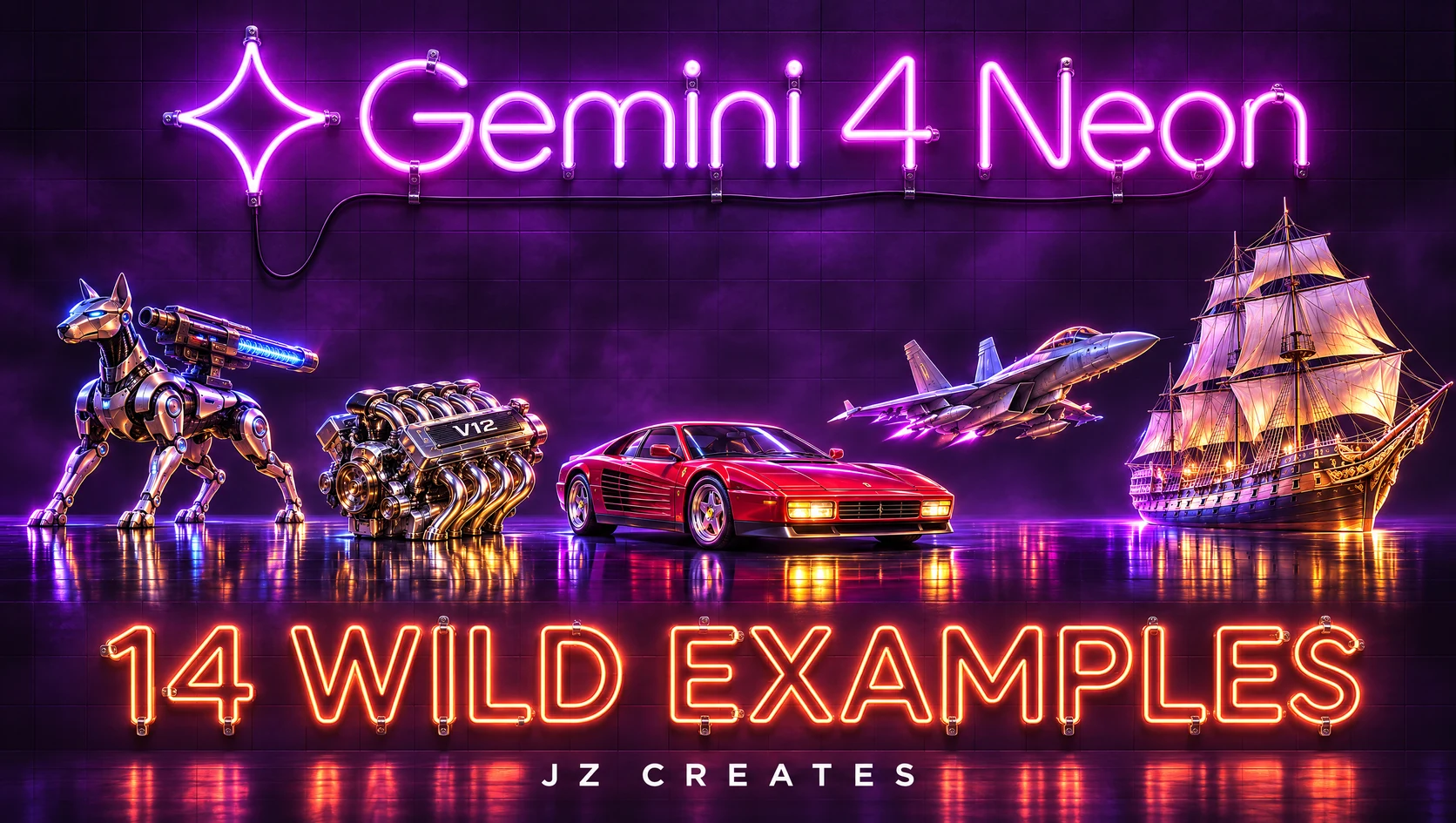
Key Takeaways
- Gemini 4 Neon examples are everywhere this week. Google released the model on November 18, and within two days builders on X were sharing 3D engines, playable games, Blender scenes, and full motion design pieces.
- Neon is the new middle of the Gemini 4 family. It sits between Hydrogen (fast everyday help) and Carbon (the heaviest work), replaces Argon, and Google says it gets close to Carbon quality at a much lower cost.
- One image is often enough. Several of the best builds below started from a single picture and a one line request, and Neon worked out the physics, animation, and lighting on its own.
- Swarm mode is the secret weapon. In Google Antigravity, Neon can act as the orchestrator for a team of Hydrogen agents working in parallel, which is how a V12 engine and a 70 object Blender scene came together.
Google Just Released Gemini 4 Neon, and People Are Building Wild Things With It
Google released Gemini 4 Neon on November 18, the third Gemini 4 model in just over a week, and the internet went straight to work. In two days, our feed filled up with Gemini 4 Neon examples that look nothing like a typical chatbot demo: a robot dog with real walking physics, a fighter jet game in a single HTML file, a stickman war between AI models, and a rainy neon street you can splash through.
We rounded up 14 of the best Gemini 4 Neon examples we have seen so far, in the order we found them most impressive. Most of them are 3D scenes and games built with code, because that is where Neon is showing off the most right now. Below each one, we explain what the creator asked for and what Neon actually did.
What Is Gemini 4 Neon?
Gemini 4 Neon is Google’s new model for complex work that still needs to move fast. It sits in the middle of the Gemini 4 lineup, between Hydrogen for quick everyday help and Carbon for the hardest projects, and it replaces Gemini 4 Argon, as 9to5Google reported. Google says it gets close to Carbon level results at a much lower cost. You can try it in the Gemini app with a Google AI Pro or Ultra plan, in Google Antigravity, and in Google AI Studio. We cover the full specs, benchmarks, and pricing after the examples.
Our Own Gemini 4 Neon Test
Before we get to the examples, here is ours. We asked Gemini 4 Neon for an interactive 3D studio built around a classic, the 1984 Ferrari 288 GTO, and it delivered a full showroom: camera angles, paint swaps, and an Exploded View that pulls the car apart into its body shell, frame, wheels, glass, and lights.
Our favorite detail is the gas pedal in the corner. Hold it down and the tachometer climbs toward the 7,750 RPM redline while a synthesized engine sound revs with it. It even put a JZ CREATES plate on the back. Watch our test below, then open the live studio and try it yourself.
Built by JZ Creates with Gemini 4 Neon. 3D model from CGTrader.
14 Gemini 4 Neon Examples That Show What It Can Do
1. A 3D V12 Engine Built by a Swarm
Bee asked Neon to build an exceptional 3D V12 engine in Three.js, with Neon as the orchestrator directing a swarm of Hydrogen agents. The result is the kind of detailed, accurate engine model you would expect from a product visualization studio.
The process is the real story. The swarm spent about two and a half hours building, reviewing its own work, and iterating until it was happy, then recorded the demo itself. Bee says it used about 71% of a five hour usage window and around 12% of the weekly limit, which is a useful reality check on what a project like this costs in Antigravity.
Video by Bee (@thtbee_)
2. A Robot Dog With a Full Physics Engine, From One Image
This is the post that made a lot of people stop scrolling. The Bugged Dev gave Neon a single image of a robotic dog carrying a railgun and asked it to build the dog in 3D. No instructions about physics or movement. Neon went ahead and built an entire biomechanics engine in Three.js with WebGPU.
That includes 240Hz physics, ground forces on all four legs, inverse kinematics, walk, trot, and gallop cycles, a spine that bends as it moves, and a head and tail that react to the railgun’s recoil. With more than 140,000 views, it is the most watched example on our list, and the creator says it also felt noticeably faster than Gemini 4 Carbon.
Video by The Bugged Dev (@thebuggeddev)
3. An Honest Side by Side Test Against Three Other Models
Not every post this week was pure hype, and we think this one is worth your time. Max bought a Pro subscription after seeing claims that Neon beats Claude Opus 5.5, then gave the same prompt to Neon and three other leading models and compared the results side by side, with each model’s output in a different color.
His verdict: the quality is close to Opus 5.5 and GPT 6.2 Astra, but Neon was almost as slow as Opus and the most expensive of the four in his test, and the $20 plan’s Antigravity limits ran out quickly. He calls it a good model that is a little overhyped. It is a fair counterpoint to keep in mind as you scroll through the rest.
Video by Max (@maxt3chno)
4. A Fighter Jet Game in a Single HTML File
LuminaBench turned a basic idea into a fighter jet game in about 30 minutes. It was built in one shot in Three.js, it lives in a single .html file, and it uses zero external assets. Everything you see on screen is generated from code.
For game designers and agencies, that last detail matters. A prototype like this can be shared as one file, opened in any browser, and tested with real players the same afternoon you had the idea.
Video by Lumina (@LuminaBench)
5. Neon Introduces Itself With Motion Design
Chetaslua asked Gemini 4 Neon to make a motion design piece introducing itself, and it is built from pure JavaScript, with not a single external asset.
This is the example we would show a creative director first. Motion design like this normally comes out of a tool like After Effects, and here it runs live in a browser from code the model wrote itself. It passed 100,000 views in a day.
Video by Chetaslua (@chetaslua)
6. A Kart Racer Set in a Pokémon World
Maximus Spritius had always wanted to play a kart racer inside the Pokémon world, so he asked Gemini Neon to make one, and he says it came together in one shot. The result is a playful fan mashup of two of the biggest game franchises ever made, and he shared a link so people can try it.
His take is that Gemini is now the leading model for game developers, partly because it is willing to just build what you ask for. It is a fan project, not something you could sell, but it shows how fast an idea can become something playable.
Video by Maximus Spritius (@MozeTech)
7. Robert Pattinson as the Next James Bond
Noclipepe put Neon’s drawing skills to the test with a fun brief: Robert Pattinson as the next James Bond. Quoting Google DeepMind’s own launch post, he called the result “actually crazy,” and more than 100,000 people agreed enough to watch it.
It is a lighter example than the 3D builds on this list, but it shows that Neon’s visual reasoning is not limited to engines and game levels. It can carry a likeness and a mood too.
Video by noclipepe (@noclipepe)
8. A Full Blender Scene With More Than 70 Objects
Christos Antonopoulos paired Gemini Neon with Blender to build a detailed town scene. The buildings, the coach, the boats, and the bus stop all started as pictures made with Nano Banana. An agent then took each reference and turned it into a finished Blender model, and the final video shows how the scene was assembled.
The scale is what got us. More than 70 distinct objects were built in parallel, each in its own cloud Blender session, in under an hour. That is the swarm idea applied to 3D production, and it hints at how much faster scene building for ads and product films is about to get.
Video by Christos Antonopoulos (@Christos_antono)
9. One Photo Turned Into an Interactive Rainy Night
AshutoshShrivastava gave Neon one static image and asked it to animate the scene in Three.js. Nothing else. On its own, Neon downloaded a depth model from Hugging Face, ran it locally on his Mac to build a depth map, sliced the image into layers, and rebuilt the photo as a 60fps interactive scene.
The finished piece has live rain, puddles you can splash, curtains you can brush aside, sparking neon signs, and rain audio it synthesized itself. He documented the whole process on his showcase site, linked in the replies. With more than 128,000 views, it is one of the most shared Gemini 4 Neon examples so far.
Video by AshutoshShrivastava (@ai_for_success)
10. A Stickman War Between AI Models
Chetaslua is back with something completely different. Using Neon inside Antigravity with swarm mode, he wrote a story and a full fight sequence where stickman versions of the top AI models battle it out, all built in Three.js with pure code.
It is funny, it is fast, and it shows Neon can handle choreography and timing, not just static scenes. He even tagged Google DeepMind CEO Demis Hassabis to say thanks for the model.
Video by Chetaslua (@chetaslua)
11. A Small 3D Game You Can Play on Your Phone
AshutoshShrivastava’s second entry is a compact 3D game he built with Gemini 4 Neon and the Swarm feature in Antigravity. It runs on both mobile and desktop, so you can actually play it, not just watch it.
He shared the full details of how he built it in the thread, which makes this a great starting point if you want to try your first swarm project.
Video by AshutoshShrivastava (@ai_for_success)
12. An Interactive Historical Sailing Ship
Synopsis asked for an interactive 3D historical sailing ship with a zero shot prompt, meaning no examples and no follow up fixes. The realism is what stands out, especially the way the ship sits on the water without the usual glitches where the hull and the waves overlap.
Synopsis says Neon outperformed GPT 6.2 Sol and 6.2 Astra on this particular test. One scene is not a benchmark, but it is a beautiful one.
Video by Synopsis (@abhinavflac)
13. Pegman Runs Through Shibuya
This one comes from JY, who says his demo lab crew shipped ten demos for Google’s launch. He asked for a neon runner game set in Shibuya, starring Pegman, the little yellow figure from Google Maps Street View. A simple prompt, the /swarm command, a few clarifying questions from the model, and some nudges later, the game was done.
Pegman drops into the map at the famous scramble crossing, weaves through traffic, grinds along rails, and lights up neon signs on his way to a finale at Google’s Tokyo office. It is a charming example of how a brand’s own characters and places could become a playable experience.
Video by JY (@agenticjay)
14. A Pelican Riding a Bike, Made of ASCII
We end with Chetaslua’s third example, and it is a clever one. Neon drew a pelican riding a bicycle entirely out of ASCII characters, a long running test of how well a model understands shapes and space.
Even better, he shared his prompt trick: run the task with /swarm and tell it to always use a blind critic that scores the visuals and points out weaknesses, and not to stop until the critic gives it at least an 8. It is a simple idea you can borrow for almost any creative task.
Video by Chetaslua (@chetaslua)
Gemini 4 Neon Benchmarks, Pricing, and Where to Use It
Now that you have seen what people are building, here is what is under the hood, based on Google’s announcement:
- A 1 million token context window, so it can read spreadsheets, PDFs, charts, audio, and video in one go.
- Four thinking levels, with high as the default and extra high for the toughest tasks.
- Built for long agent work. Google says it handles long, tool heavy tasks from start to finish, makes targeted code edits instead of rewriting everything, and had the lowest fabrication rate of any model in its internal Antigravity testing.
- Swarm mode in Google Antigravity. Neon can run as an orchestrator that directs a group of Hydrogen subagents working in parallel. That is the /swarm command you saw in several examples above.
The benchmark numbers back up the hype. These are Google’s figures from launch day:
| Benchmark | Gemini 4 Neon score | What it tells you |
|---|---|---|
| Artificial Analysis Coding Agent Index | 58.6, #1 overall | How well it works as a hands on coding agent |
| Artificial Analysis Intelligence Index | 61, #3 overall | General intelligence, just behind larger, slower models |
| Agent Arena Index | 1336, #2 globally | Real agent sessions judged by people, across 4,200+ runs |
| Terminal Bench 4.1 | 65.2% | Completing real tasks in a command line |
| Zapier AutomationBench | 56.3%, #1 overall | Running business automations end to end |
| Vending Bench 2 | $16,843, #1 overall | Running a simulated business over a long stretch |
Swipe sideways to see the full table →
Where you can use it: Gemini 4 Neon is available in the Gemini app for Google AI Pro and Ultra subscribers (pick “Deeper analysis” in the model menu), in Google Antigravity for paid Pro and Ultra plans, and through the Gemini API in Google AI Studio. Developers can also use it in Android Studio and Gemini Enterprise. API pricing is $3 per million input tokens and $15 per million output tokens, with cached input at $0.15. That is twice the price of Hydrogen, but about 25% cheaper than Argon and Carbon once their launch promo ends on November 30.
Why These Gemini 4 Neon Examples Matter
Look past the games and a pattern shows up. The best results did not come from long, detailed prompts. They came from a clear idea, a single image, or a short brief, and then the model was trusted to work through the details: physics, lighting, depth, timing, and even its own quality checks. The swarm approach, one smart model directing many fast ones, is what turned two hour builds into finished, polished work.
For brands, that opens up a lot. Interactive product demos, playable campaign microsites, animated brand intros, and 3D scenes for ads can now be prototyped in an afternoon instead of quoted over weeks. We have been seeing the same shift in GPT 6 Astra examples and in generative AI advertising more broadly. The tools are getting more capable, and the creative direction behind them matters more than ever.
It is still early. Usage limits are tight, costs add up on long projects, and as Max’s test showed, Neon does not win every comparison. But two days in, these examples are some of the most creative work we have seen from any new model this year.
What We Use at JZ Creates
We are a creative agency in LA focused on AI and automation for brands, so new models like Neon go straight into our testing. Gemini already lives inside our day to day through Google Workspace, where it reads our Gmail and Docs. For image and video generation, including Nano Banana and the latest video models, we use Kie.ai, a pay as you go hub with no forced subscription. Screen recordings and demo edits come together in CapCut, and the repetitive steps in between run on n8n automations.
How JZ Creates Can Help
If these builds have you thinking about an interactive product demo, a playable campaign, or an animated brand piece of your own, that is exactly the kind of work our team loves. At JZ Creates, we produce captivating, engaging content for brands across social and digital, from cinematic AI video to full AI creative services. Browse more breakdowns like our best AI video generators of 2026 on our blog, or contact us today and let’s build something people want to play with.
Gemini 4 Neon FAQ
What is Gemini 4 Neon?
Gemini 4 Neon is a Google AI model released on November 18, 2026. It sits between Gemini 4 Hydrogen and Gemini 4 Carbon, replaces Gemini 4 Argon, and is built for complex coding, analysis, and long agent tasks at a faster speed and lower cost than Carbon. It has a 1 million token context window and four thinking levels.
How can I try Gemini 4 Neon?
If you have a Google AI Pro or Ultra subscription, choose Deeper analysis in the Gemini app’s model menu. Developers can use it through the Gemini API in Google AI Studio, and paid Pro and Ultra subscribers can use it in Google Antigravity, including swarm mode.
How much does Gemini 4 Neon cost?
In the API, Gemini 4 Neon costs $3 per million input tokens and $15 per million output tokens, with cached input at $0.15 per million. In the Gemini app and Antigravity, it is included with Google AI Pro and Ultra plans, with usage limits.
What are the best Gemini 4 Neon examples so far?
Some standouts from launch week are a robot dog with a full physics engine built from one image, a 3D V12 engine built by a swarm of agents, a photo turned into an interactive rainy night scene, a fighter jet game in a single HTML file, and a 70 object Blender scene built in under an hour.
What is swarm mode in Google Antigravity?
Swarm mode lets Gemini 4 Neon act as an orchestrator that splits a project into parts and directs a group of faster Gemini 4 Hydrogen agents working on them in parallel. Creators start it with the /swarm command, and many of the most ambitious Gemini 4 Neon examples were built this way.

About Jay Hernandez
Jay Hernandez is an award-winning Creative Director with 20+ years of driving standout campaigns for top brands. Based in Los Angeles, he blends deep creative expertise with cutting-edge AI tools to help businesses and marketing teams unlock bold, breakthrough ideas that deliver real impact. If you are ready to elevate your brand and turn big visions into unforgettable campaigns, connect with Jay and make it happen.