AI Architectural Rendering for Homes That Don’t Exist Yet: See the $50M Estate We Built!
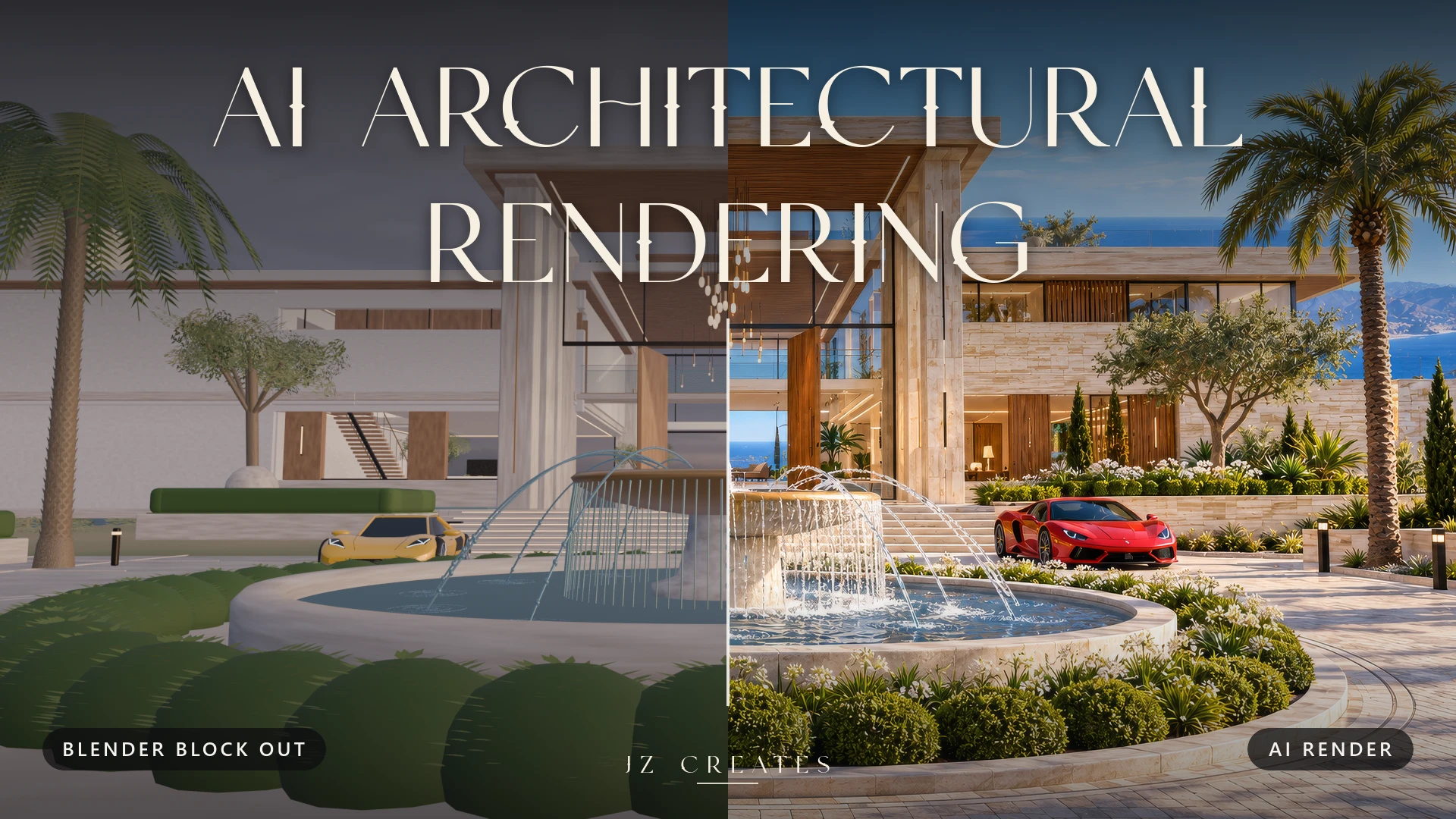
Sponsored
Sponsored
Key Takeaways
- AI architectural rendering lets builders, developers and architects show a finished luxury home before construction even starts.
- No photographer, drone, film crew, location or actors: the house, the light and even the listing agent are created digitally.
- You can test styles, materials, furniture and times of day on the same house before committing to one look.
- One 3D model can become photoreal renders, floor plans, cinematic films and an AI presenter, all showing the same house.
- It’s built for concepts, pre-construction marketing and luxury listings. It doesn’t replace construction documents or spec-accurate finishes.
How do you sell a $50 million home that has never been built? No photographer can shoot it. No drone can fly it. No agent can walk a buyer through it.
That question is exactly why we created Coastal Residence, a concept estate on the Malibu coast built to show what AI architectural rendering can really do for luxury real estate. The house is fictional. Every image, plan and film you’re about to see was created without a single camera, crew or location.
What Is AI Architectural Rendering?
AI architectural rendering uses generative AI to turn a 3D massing model, a sketch or a floor plan into photorealistic images and video of a building, including buildings that don’t exist yet. Think of it as architectural visualization without the photo shoot: it shows the finished materials, the light, the landscape and the view as if the home were already standing.
For luxury real estate, that changes what you can market and when. Traditionally, a home that isn’t built yet can only be sold with drawings, a few images from architectural rendering services and a lot of imagination. AI architectural rendering gives buyers a full visual campaign instead.
What AI Architectural Rendering Makes Possible
This is the part that surprised even us. Once the house exists digitally, almost every limit of a traditional shoot disappears.
Market a Home Before It’s Built
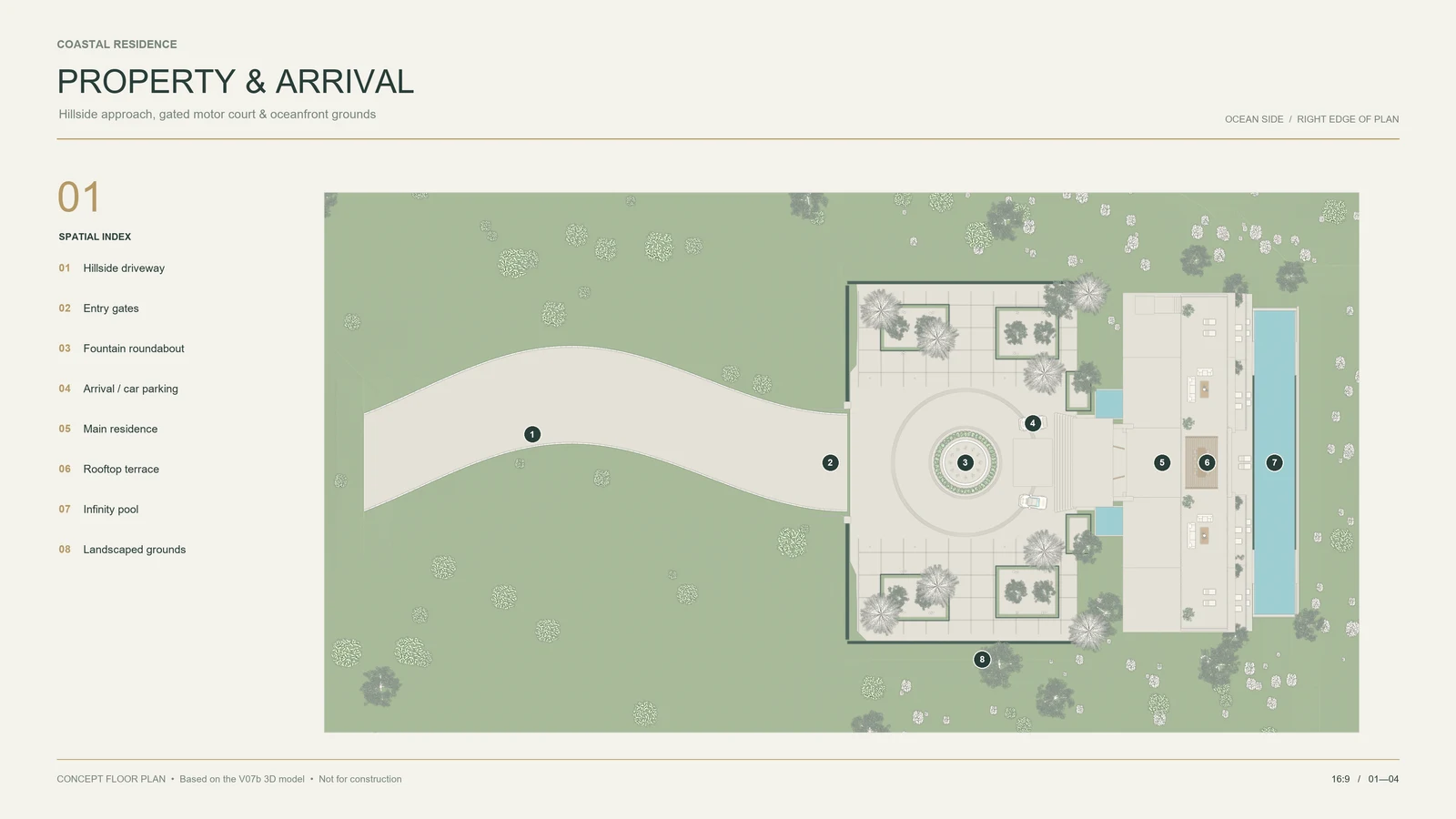
A lot, a set of plans or a concept is enough to start. Coastal Residence has an arrival court with a fountain, a double height great room, four ocean facing suites, a 175 foot infinity pool and a rooftop terrace, and none of it exists. Builders and developers can open sales, test demand and build a waiting list while the site is still dirt.
No Cameras, Crews, Locations or Actors
There’s no photographer to book, no drone permit, no golden hour to wait for and no staging company to hire. The same goes for people. Mark, the listing agent who presents Coastal Residence, is an AI presenter designed for the project, so there was no casting, no wardrobe and no retakes.

Test Different Looks Before You Commit
This is where AI architectural rendering gets genuinely exciting for a sales team. The same room can be shown at sunrise, midday or golden hour. Stone can become oak, ivory can become charcoal, and the landscaping can go from coastal to tropical, all without touching the design.
That means you can present options to an investor, match the mood to a specific buyer, or run two looks in an ad campaign and see which one pulls more interest.

Change the Design Without Starting Over
Real projects change. Coastal Residence went through eight design revisions, from adding a fourth suite to moving the rooftop deck. Because the visuals come from one digital model, a design change updates the whole campaign instead of forcing a new commission for every image.
One Model, Every Format
The same house became photoreal stills, four floor plan sheets, a cinematic film, two agent tours and before and after videos for social. Every asset shows the same rooms in the same places, which is exactly what buyers need to trust a home they can’t visit.
Before and After: 3D Block Out vs AI Architectural Rendering
Every finished image started as a rough 3D block out. Same camera, same layout, same furniture positions. AI added the materials, the light, the landscaping and the Pacific, turning a grey model into a photorealistic rendering.
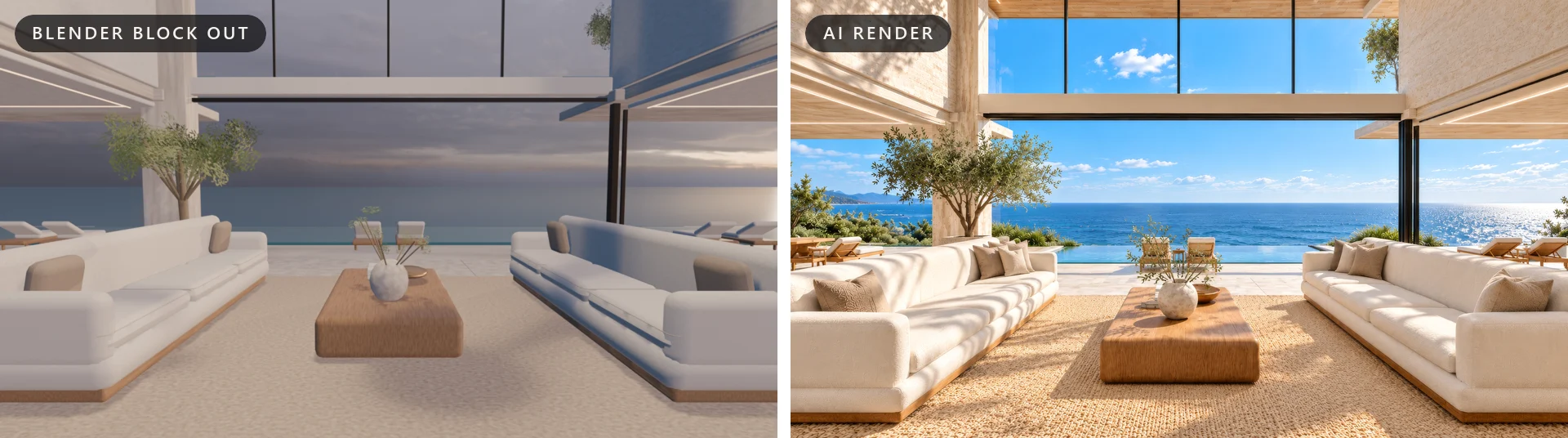
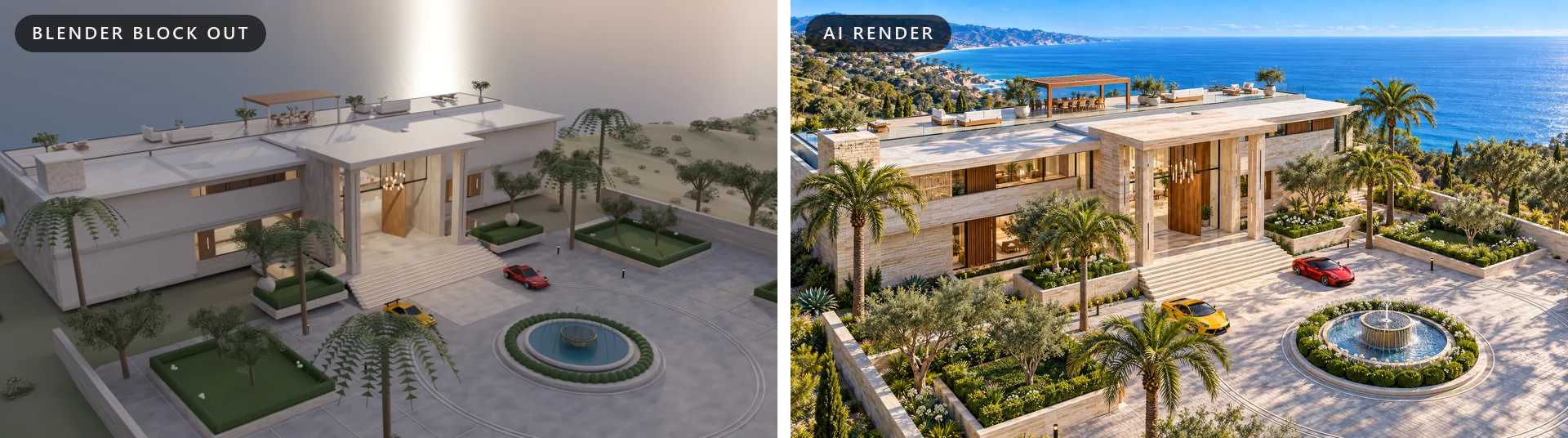
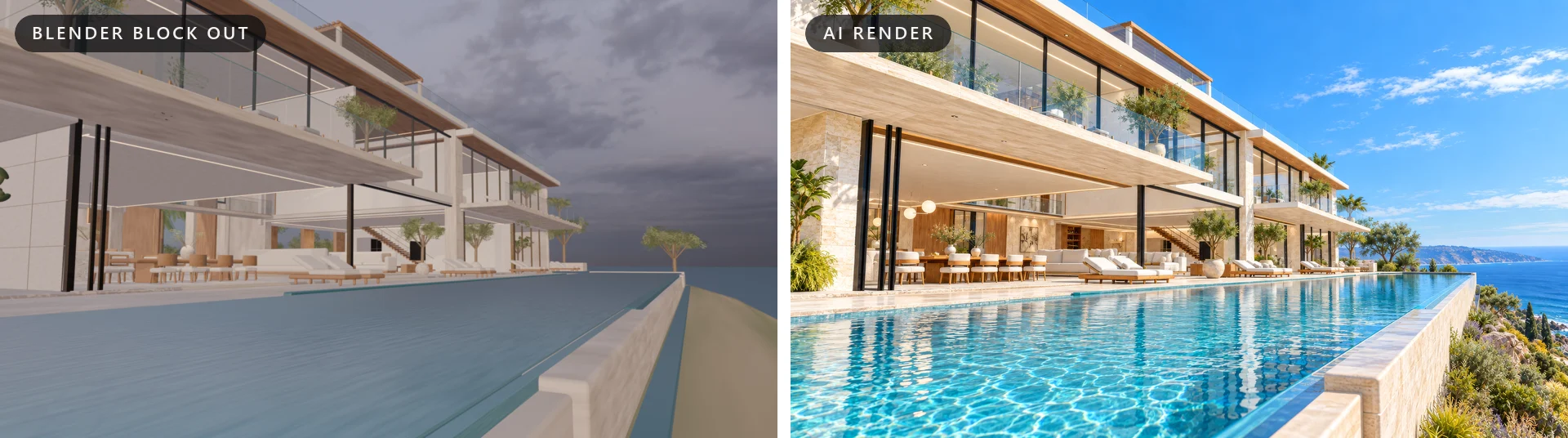
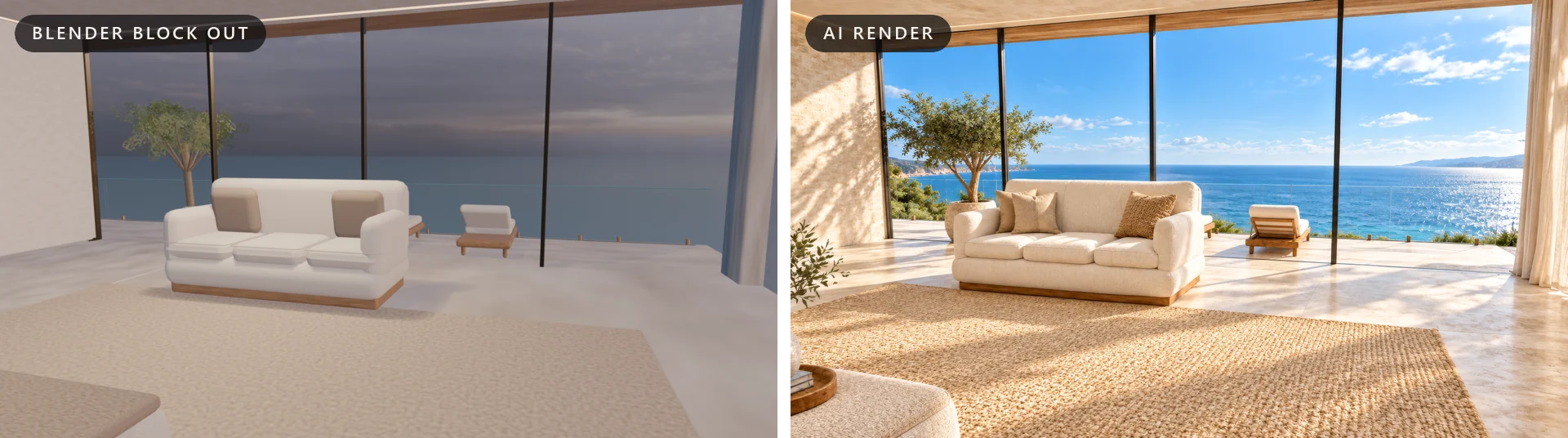
You can drag through all 13 before and after pairs yourself on the Coastal Residence project page.
How We Keep AI Architectural Rendering Accurate
The biggest risk with AI images is what Google’s own AI Overview calls geometric hallucination: the model quietly changes the roofline, adds a floor or moves the pool between shots. For a mood board that’s fine. For a listing, it breaks trust.
Our approach rests on three rules:
- Design the building first, then let AI finish it. Every image starts from our own 3D model in Blender, so the architecture is designed, not invented.
- Keep one source of truth. Every render, plan and film comes from the same model, so the house never contradicts itself.
- Review every frame. Anything that drifts from the model gets cut. We dropped renders from Coastal Residence rather than ship a single one that didn’t match the house.
AI Real Estate Video: A Cinematic Film and an AI Listing Agent
Most AI real estate video tools animate existing listing photos. That doesn’t help real estate video marketing when there are no photos yet. For Coastal Residence, the renders became a cinematic overview film, edited in Adobe Premiere Pro with music from Envato Elements.
Then Mark took over. We produced two tours, each a real estate video walkthrough with the same agent and a different script: one leads with the numbers buyers ask about, the other sells the feeling of living there. Same house, two ways to sell it, and a simple way to test which message lands with your audience.
Traditional 3D Architectural Rendering vs AI: What Changes
Here’s how traditional 3D architectural rendering and AI architectural rendering compare on the things builders and developers care about.
| Traditional 3D architectural rendering | AI architectural rendering | |
|---|---|---|
| Starting point | Fully modeled and textured to the drawings | A 3D model, plan or sketch, finished by AI |
| A new view | A new setup and a new render | A new camera angle on the same model |
| Exploring looks | Each option is its own render job | Materials, light and seasons are easy to test |
| Design changes | Re-texture and re-render | Update the model and regenerate |
| Video and presenters | A separate animation and casting budget | The same assets feed AI video and an AI presenter |
| Exact products and finishes | Exact | Close, but not specification accurate |
| Construction documents | Yes, with CAD or BIM | No |
| Best for | Final approvals and spec accurate sales material | Concepts, pre-construction marketing and full campaigns |
Traditional ray traced engines like V-Ray still win when every tile and fixture has to be exact. AI wins on range, flexibility and everything around the still image.
Where AI Architectural Rendering Still Falls Short
We love what this makes possible, and we’re honest about its limits.
- It’s not documentation. Nothing here replaces drawings a contractor can build from.
- Materials are close, not specified. If a buyer is paying for a named stone or a specific fixture, render it traditionally or correct it by hand.
- It needs a trained eye. AI drifts. Someone has to catch it before a buyer does.
- Label it clearly. Images of an unbuilt home should be presented as renderings or concept imagery, so buyers know what they’re looking at.
Who This Is For
Luxury Home Builders
Show buyers a finished home, inside and out, while the lot is still dirt. The same real estate 3D rendering work then covers your website, sales office screens and social.
Real Estate Developers Selling Before Construction
Pre-construction campaigns need volume: many views, many formats and updates when the design evolves. AI architectural rendering keeps the whole campaign in step with the plans.
Architects Presenting Concepts
This is where AI rendering for architects shines. Show clients finishes, light and landscape on your own design, and let them feel a space before it’s drawn in full detail.
If you want to go deeper on the motion side, our breakdown of AI video production and our look at video with 3D are good next reads.
What We Actually Use at JZ Creates
We run JZ Creates, a creative agency in Los Angeles focused on content, AI and automation for brands, including luxury goods and luxury experiences. Coastal Residence came together with Blender for the 3D model and floor plans, AI image generation for the renders, Adobe Premiere Pro for the edit and Envato Elements for music. For AI video generation across models we use Kie.ai, which is pay as you go. If you’re comparing video models, our best AI video generators guide ranks them by job.
The Bottom Line
If you’re a builder, developer or architect who needs to sell a home before it exists, that’s exactly the kind of AI architectural rendering and AI real estate video our team creates. At JZ Creates, we produce captivating, engaging content for brands, and we build the AI workflows behind it so every project looks premium from the first frame. See the full Coastal Residence case study, explore our AI creative services, or contact us with your plans, sketches or references and let’s talk about what your project could look like.
Frequently Asked Questions
Can ChatGPT do architectural renderings?
Yes. ChatGPT is one of several architectural rendering AI tools that can produce convincing results, and we used AI image generation for Coastal Residence. On its own, though, it tends to change the building between shots. Starting every image from a real 3D model is what keeps a whole campaign consistent.
How does AI architectural rendering work?
The building is designed first, usually as a 3D model, plan or sketch (sketch to render AI tools start from a drawing). AI then adds realistic materials, lighting, landscaping and atmosphere, producing photoreal images and video. A person reviews every result against the design so the architecture stays accurate.
Is AI architectural rendering accurate enough to market a listing?
For layout, scale and mood, yes, as long as every image comes from the same design and is reviewed by a person. It isn’t specification accurate for exact finishes, so label images as renderings and render named products traditionally when precision matters.
Can you make an AI real estate video of a home that isn’t built yet?
Yes. Most AI real estate video tools animate existing listing photos, but you can start from AI renders of a home that only exists as a design. We turned Coastal Residence into a cinematic film and two tours presented by an AI listing agent.
Do you still need a photographer or film crew?
Not for a home that isn’t built yet. AI architectural rendering and AI real estate video replace the shoot, the location, the staging and the presenter. Once the home is finished, real photography and AI visuals can work together in the same campaign.

About Jay Hernandez
Jay Hernandez is an award-winning Creative Director with 20+ years of driving standout campaigns for top brands. Based in Los Angeles, he blends deep creative expertise with cutting-edge AI tools to help businesses and marketing teams unlock bold, breakthrough ideas that deliver real impact. If you are ready to elevate your brand and turn big visions into unforgettable campaigns, connect with Jay and make it happen.
Share This Article
Sponsored