AI Commercials: How They’re Made and What They Cost
Sponsored
Sponsored
Key Takeaways
- An AI commercial is a TV, streaming, or social ad where most of the footage, voice, or music is generated with AI tools instead of filmed on a traditional set.
- They’re everywhere because the math changed: the IAB found about 30% of digital video ads already use generative AI, with roughly 40% expected by 2026.
- There’s no single price tag. Cost follows creative development, how many generations it takes to get usable shots, the edit, and licensing, not crew days.
- The AI commercials audiences enjoy start from a clear idea and a familiar brand world. The tool always comes second.
- People still matter: SAG-AFTRA’s 2025 commercials contracts require performer consent and pay for digital replicas.
A betting company aired a nationally broadcast AI commercial during the NBA Finals, made by one creator in about two days. A year later, a vodka brand ran what reviewers called the first Super Bowl spot produced mostly with AI. If you lead marketing, the question has shifted from “will brands do this?” to “how do we do it well, and what should it cost?”
Let’s break down exactly that: how an AI commercial gets made, how it compares to a traditional shoot, and what separates the spots people share from the ones they scroll past.
What Is an AI Commercial?
An AI commercial is an advertisement where generative AI creates most of the visuals, and often the voiceover and music, from scripts, reference images, and prompts. A creative team still writes the idea, directs the look, selects the best generations, and edits them into a finished spot ready for TV, streaming, or social.
Think of it as a production method, not a genre. It can be a 6 second bumper, a 30 second broadcast spot, or a vertical ad built for paid social. What changes is how the footage comes to exist: rendered from direction instead of captured on location.
If you want to see the range of styles first, our roundup of AI commercials worth watching is a great place to start. This piece focuses on the production and budget side.
Why Brands Are Suddenly Running AI Commercials
Three moments pushed AI commercials into the mainstream.
Kalshi at the NBA Finals. In June 2025, Kalshi ran a fully AI generated spot during the Finals. According to NPR’s reporting, creator PJ Accetturo made it with Google’s Veo 3, using Gemini for prompts and CapCut for the edit, in about two days.
Coca-Cola’s holiday classic. For the 2024 season, Coca-Cola reimagined “Holidays Are Coming” with AI studios Secret Level, Silverside AI, and The Wild Card. Its European CMO said the brief was to bring the ad into the present, and AI came in as the solution, not the starting point.
Super Bowl LX. In February 2026, Svedka’s “Shake Your Bots Off” was widely described as the first Super Bowl ad produced primarily with AI, alongside a wave of AI brands buying airtime.
Behind the headlines is a broader shift. The IAB’s 2025 video ad research found about 30% of digital video ads were already built or enhanced with generative AI, with buyers expecting roughly 40% by 2026 (coverage via The Desk). This is becoming a normal line in the media plan.
AI Commercial vs a Traditional Shoot
Here’s how the two approaches compare on the factors a CMO actually weighs.
| Factor | Traditional commercial | AI commercial |
|---|---|---|
| Timeline | Weeks of preproduction, a shoot, then post | Days to a few weeks, mostly in development and edit |
| Team on the day | Director, crew, talent, locations | A small creative team at workstations |
| Locations and sets | Booked, built, permitted | Generated from reference and prompts |
| Revisions | Reshoots are costly | Regenerate a shot, keep the rest |
| Versions | Each cut adds edit time | Many variations from one master |
| Strongest when | Real people, real products, real places must be shown exactly | Stylized worlds, impossible shots, fast testing |
Swipe sideways to see the full table →
Neither column wins everywhere. The smartest campaigns we see blend them: real product footage where accuracy matters, AI where imagination and speed matter. Our guide to AI video production covers that blend in depth.
How Much Does an AI Commercial Cost?
There’s no standard price for an AI commercial. Cost depends on creative development, the number of generations needed to get usable shots, editing and sound, voice and music licensing, and any broadcast clearance. It usually lands well below a comparable live action shoot, but a polished spot still needs skilled people.
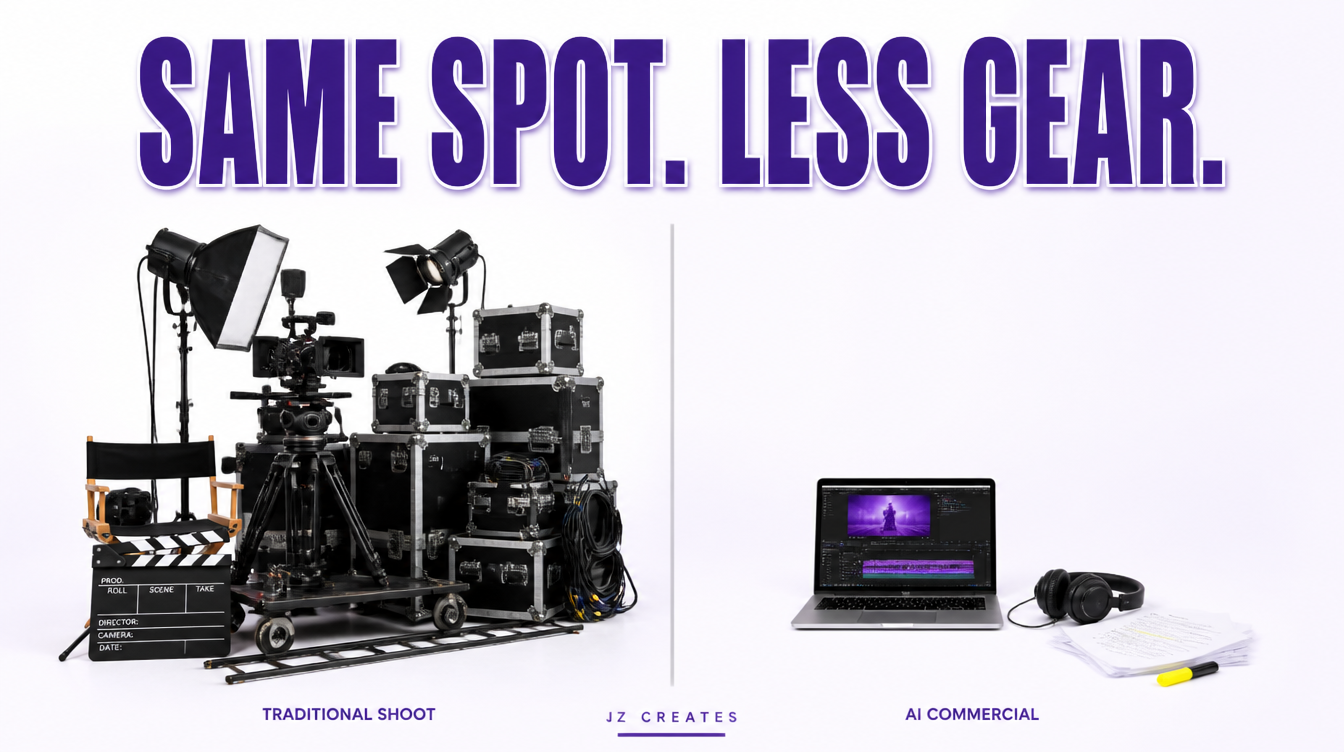
The best public data point is Kalshi. Accetturo described roughly 300 to 400 generations to land 15 usable clips, and estimated a 95% cost reduction against traditional advertising. Treat that as one creator’s estimate, not an industry benchmark.
Where the budget goes:
- Creative development. The concept, script, and storyboard. This is still the biggest lever on results.
- Generation time. Credits and hours spent directing shots until they match the storyboard.
- Edit, sound, and voice. Pacing, music, sound design, and voiceover.
- Licensing and clearance. Music rights, any human likeness, and network standards review for broadcast.
Notice what’s missing: equipment rentals, location fees, and crew days. That’s where the savings live.
How an AI Commercial Actually Gets Made
The workflow looks a lot like traditional advertising, with the middle rebuilt.
Stage 1: Script and Storyboard
Everything starts with the idea. We draft scripts and beat sheets with Claude, then turn the approved script into a shot by shot storyboard. Every frame gets a description precise enough to direct a generation.
Stage 2: Generating the AI Commercial Footage
Each storyboard frame becomes a prompt. We generate stills first to lock the look, then animate them into motion. A typical shot prompt reads like a director’s note:
Shot prompt: “Slow push in on a frosted glass bottle on a wet marble counter, morning window light from the left, condensation beads catching highlights, shallow depth of field, 35mm commercial look, warm citrus palette, 4 seconds.”
Expect to generate far more than you keep, then choose like an editor.
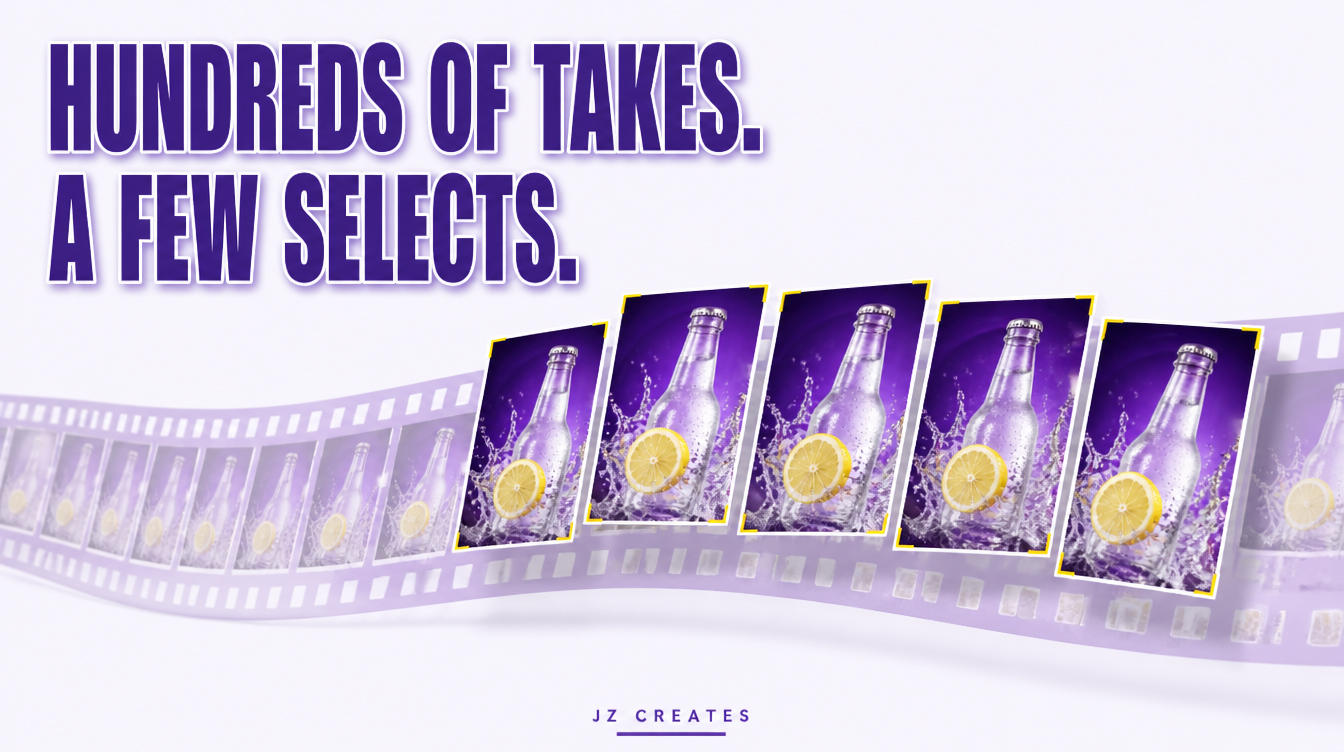
That’s the Kalshi pattern: hundreds of takes, a handful of selects. Picking the shots that tell the story is where taste shows up on screen.
Stage 3: Voice, Music, and the Edit
Voiceover comes from ElevenLabs, music and sound design get layered in, and the edit gives the spot its rhythm. This stage turns clips into a commercial.
Stage 4: Review, Clearance, and Versions
Brand, legal, and accuracy checks happen before anything ships. Then the master gets cut into every length and aspect ratio the media plan needs.
What the AI Commercials People Love Have in Common
After studying the spots that earned praise and the ones that drew mixed reactions, a few patterns stand out.
They start with an idea, not a tool. Coca-Cola’s own framing proves it: the brief came first, AI second. A spot built to show off a model feels like a demo. A spot built around a feeling feels like an ad.
They lean into what AI does best. Surreal worlds, impossible camera moves, and heightened style play to the medium’s strengths. Kalshi’s spot was deliberately chaotic and over the top, and it fit the brand’s voice.
They keep the product honest. The safest approach for product hero shots is real photography or tightly controlled generation, so nothing misrepresents what the customer buys.
“AI changes how the footage gets made. It doesn’t change why anyone watches.”
They’re cut for the platform. A broadcast spot, a vertical social cut, and a 6 second bumper are three different edits. For the social side, our breakdown of AI UGC ads shows how a single concept gets reworked for each feed.
Where an AI Commercial Still Needs People
Even a fully generated spot has humans all over it. The idea, the art direction, the selects, and the final edit are human calls.
Performers matter too. Under SAG-AFTRA’s 2025 commercials contracts, performer consent is required before a digital replica is created, and when a replica delivers a performance the actor would have given in person, the actor is paid for it (details via TheWrap). If a recognizable person appears, plan for consent and compensation from day one.
Disclosure is the other piece. Platforms increasingly label AI generated content, and audiences respond well to brands that are upfront about it. We cover where generative tools fit inside a full campaign in our piece on generative AI advertising.
What We Actually Use at JZ Creates
We run JZ Creates, a creative agency in Los Angeles focused on content, AI, and automation for brands across consumer products, luxury, music festivals, authors, entertainment, and events. Our team spent 20+ years at LA creative agencies producing campaigns for major Hollywood studios, so we approach these spots the way we’d approach any spot: idea first, craft always.
Our core stack: Claude for scripts, beat sheets, and shot prompts. Kling for turning approved frames into cinematic motion. Kie.ai for pay as you go access to multiple image and video models without a forced subscription. ElevenLabs for voiceover. Google Workspace for scripts, storyboards, and client review rounds in one shared place. You can see the kinds of projects this stack powers on our AI creative services page, and how the models compare in our list of the best AI video generators.
The Bottom Line
If you’re planning an AI commercial, whether it’s a broadcast spot, a product launch film, or a set of paid social cuts, building them from script to final edit is exactly what our team does for brands. At JZ Creates, we specialize in producing captivating and engaging content for social and digital media. If your project needs highly creative content, contact us so we can bring your vision to life!
Frequently Asked Questions
How much is an AI commercial?
There’s no fixed price. An AI commercial’s cost depends on creative development, the number of generations needed, editing and sound, voice and music licensing, and broadcast clearance. It’s typically far less than a comparable live action shoot because there are no crew days, rentals, or location fees, but a polished spot still needs experienced creative direction.
What’s with all the AI commercials?
Generative video tools reached broadcast quality, and brands saw they could produce stylized spots faster and test more versions. High profile examples like Kalshi’s NBA Finals ad and Coca-Cola’s AI version of “Holidays Are Coming” pushed the approach into the mainstream, and the IAB found about 30% of digital video ads already use generative AI.
How many commercials are made with AI now?
According to the IAB’s 2025 video ad research, about 30% of digital video ads were already created or enhanced with generative AI, and ad buyers expected that share to reach roughly 40% by 2026. Fully AI generated broadcast commercials are a smaller slice, but the number grows every quarter.
Do actors get paid for AI commercials?
Under SAG-AFTRA’s 2025 commercials contracts, a performer must consent before a digital replica is created, and when that replica delivers a performance the actor would otherwise give in person, the actor is paid for it. Commercials that use fully synthetic characters, with no real performer’s likeness, work differently.
How do you make a commercial with AI?
Write the script and storyboard first, then turn each frame into a detailed prompt and generate stills to lock the look. Animate the approved stills into video, add AI voiceover, music, and sound design, and edit for pacing. Finish with brand and legal review, then cut versions for every platform.

About Jay Hernandez
Jay Hernandez is an award-winning Creative Director with 20+ years of driving standout campaigns for top brands. Based in Los Angeles, he blends deep creative expertise with cutting-edge AI tools to help businesses and marketing teams unlock bold, breakthrough ideas that deliver real impact. If you are ready to elevate your brand and turn big visions into unforgettable campaigns, connect with Jay and make it happen.
Share This Article
Sponsored